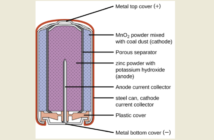
Capacitors are like batteries, in that both store electricity. Both also have two terminals separated by an insulating layer. After that, the similarity ends. Capacitors cannot produce new electrons. They must make do with what they receive. There are many different capacitor types in use today. Let’s venture forth and find out how they work.
Common Components All Capacitor Types Have

A capacitor is an incredibly simple device with only three components. These are two electrical conductor ‘plates’ and a ‘dielectric’ insulator keeping them apart.
You may find it helpful to remember the phrase ‘die electric’ although this is not actually what happens.
A coating surrounds these three parts with just the connecting wires protruding. We use various capacitor types, or ‘caps’ to act as temporary ‘batteries’. These can power a circuit when other energy is not present. Moreover if we combine them with resistors, we can control the timing of events such as buzzers and LED lights.
A Simple Example of a Capacitor in Action
If we connect a suitable capacitor to a battery, it will develop the same voltage potential. If we introduce an appropriate light bulb, it will glow. However when we bypass the battery, the bulb will only burn for a short while longer. Currently scientists are working on super capacitors that could eventually surpass batteries.
Different Capacitor Types in Use Today

The main differences between capacitor types are their insulating materials. To explain this we will be discussing ceramic, film, electrolytic, and super capacitors in future posts.
After that, we plan to explore some exciting new developments in the world of supercapacitors.
An electric storm is like a super capacitor in action. In this model the clouds above and the ground below become the ‘plates’ when ‘dielectric’ lightning strikes. Now that is an awesome event we had not thought of before.
Related