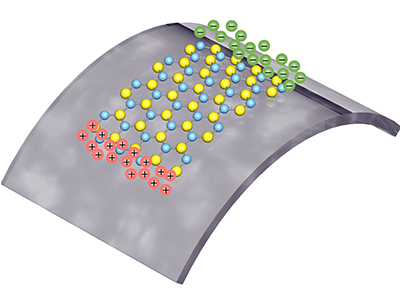
Researchers from Columbia Engineering and the Georgia Institute of Technology have currently reported that they have made the first experimental observation of piezoelectricity and the piezotronic effect in an atomically thin material, molybdenum disulfide (MoS2).
This resulted in a unique electric generator and mechanosensation devices that are optically transparent, extremely light and very flexible.
In a recent paper published in Nature, research groups from the two institutions demonstrate the mechanical generation of electricity from the two-dimensional (MoS2) material. The piezoelectric effect in this material had previously been predicted theoretically.
Piezoelectricity is a well-known effect in which stretching or compressing a material causes it to generate an electrical voltage (or the reverse, in which an applied voltage causes it to expand or contract).
However, for materials of only a few atomic thicknesses, there hasn’t been any experimental observation of piezoelectricity made, until now. The observation reported today provides a new property for 2D materials such as molybdenum disulfide, opening the potential for new types of mechanically controlled electronic devices.
“This material — just a single layer of atoms — could be made as a wearable device, perhaps integrated into clothing, to convert energy from your body movement to electricity and power wearable sensors or medical devices, or perhaps supply enough energy to charge your cell phone in your pocket,” says James Hone, professor of mechanical engineering at Columbia and co-leader of the research.
“Proof of the piezoelectric effect and piezotronic effect adds new functionalities to these two-dimensional materials,” says Zhong Lin Wang, Regents’ Professor in Georgia Tech’s School of Materials Science and Engineering and a co-leader of the research. “The materials community is excited about molybdenum disulfide, and demonstrating the piezoelectric effect in it adds a new facet to the material.”
Hone and his research group demonstrated in 2008 that graphene, a 2D form of carbon, is the strongest material. Along with Lei Wang, a postdoctoral fellow in his group, Hone has been actively exploring the novel properties of 2D materials like graphene and MoS2 as they are stretched and compressed.
Zhong Lin Wang and his research group pioneered the field of piezoelectric nanogenerators for converting mechanical energy into electricity. He and postdoctoral fellow Wenzhuo Wu are also developing piezotronic devices, which use piezoelectric charges to control the flow of current through the material just as gate voltages do in conventional three-terminal transistors.
There are two keys to using molybdenum disulfide for generating current using an odd number of layers and flexing it in the proper direction. The material is highly polar, Zhong Lin Wang notes, so an even number of layers cancels out the piezoelectric effect. The material’s crystalline structure is also Piezoelectric in only certain crystalline orientations.
For the Nature study, Hone’s team placed thin flakes of MoS2 on flexible plastic substrates and determined how their crystal lattices were oriented using optical techniques. They then patterned metal electrodes onto the flakes. In research done at Georgia Tech, Wang’s group installed measurement electrodes on samples provided by Hone’s group, then measured current flows as the samples were mechanically deformed. They monitored the conversion of mechanical to electrical energy, and observed voltage and current outputs.
The researchers also noted that the output voltage reversed sign when they changed the direction of applied strain, and that it disappeared in samples with an even number of atomic layers confirming theoretical predictions published last year. The presence of piezotronic effect in odd layer MoS2 was also observed for the first time.
“What’s really interesting is we’ve now found that a material like MoS2, which is not piezoelectric in bulk form, can become piezoelectric when it is thinned down to a single atomic layer,” says Lei Wang.
Material must break central symmetry, to be considered piezoelectric. A single atomic layer of MoS2 has this type of structure, and should be piezoelectric. However, in bulk MoS2, successive layers are oriented in opposite directions, and generate positive and negative voltages that cancel each other out and give zero net piezoelectric effect.
“This adds another member to the family of piezoelectric materials for functional devices,” says Wenzhuo Wu.
Zhong Lin Wang notes, ultimately, the research could lead to complete atomic-thick nanosystems that are self-powered by harvesting mechanical energy from the environment. This study also reveals the piezotronic effect in two-dimensional materials for human-machine interfacing, robotics, MEMS, and active flexible electronics.
At UPS Battery Center, our goal isn’t to only sell batteries, we want to inform and teach you about the amazing world of batteries, electricity and energy. Please check back for more interesting, helpful and informative articles about batteries and electricity.
Related Articles:
A New Way to Generate Electricity Could Do Away with Batteries in the Future
What are portable solar power generators?
Different Activities That Demonstrates The History Of Electricity
How To Make A Simple Generator
The Difference Between Electric Charge and Electric Current