Device manufacturers have had to adapt their designs to the shapes, sizes and proportions of batteries until quite recently. We’ve seen a generation of flat, slim-line laptops and phones. If you have been hankering for something more ergonomic, then a press release from the American Chemical Society will delight you. Because US scientists have found a way to make 3D-printed lithium-ion batteries.
3D-Printed Lithium-Ion Batteries and More
In theory we could print a phone complete with battery in any shape. We could even make an apple-shaped electric car with the battery as the core. However that might not be practical in terms of our current world view.
The point is we have an opportunity to make 3D-printed lithium-ion batteries in almost any shape. Although we still have a way to go with flat screen technology before we have a completely free hand with phone and laptop design. To date, these ideas have not left the starter’s blocks because 3D printing polymers are unable to conduct ions.

The Breakthrough at Duke and Texas State Universities
Batteries function through the exchange of ions between pairs of electrodes. The ions move in one direction during charging, and the other way during use. The Texas State and Duke University scientists achieved this by infusing the printing polymer with an electrolyte.
Then they went a stage further by incorporating graphene in the anode, and multi-walled carbon nanotubes in the cathode. In other words, they selectively adapted the printing polymer for the different parts of the battery, and it worked at the experimental level.
They printed an LED bangle with an integrated lithium-ion battery. And powered a green LED for about sixty seconds. These are baby steps indeed, but their 3D-printed lithium-ion batteries could be a giant leap forward for technology. Their next experiment will use 3D printable pastes which they hope will produce more power.
Related
3D Printing Next Gen Battery Electrodes
Carbon Nanotubes: Replacing Silicon In Circuits
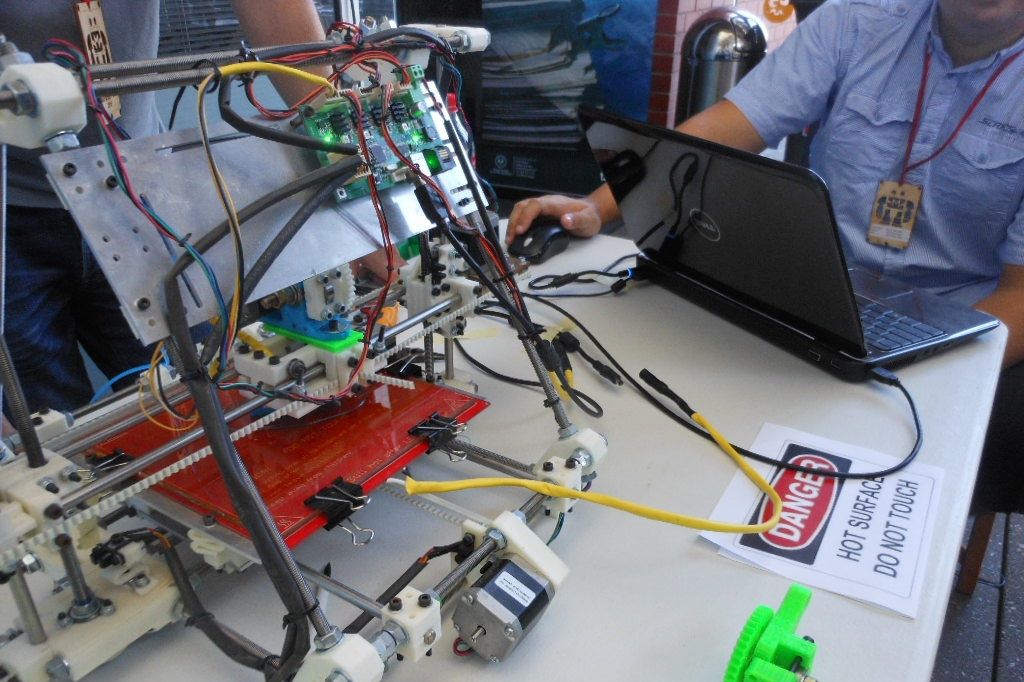
Preview Image: Laptop and 3D Printer
Research Report: https://pubs.acs.org/doi/abs/10.1021/acsaem.8b00885