


The Smithsonian Institute – AKA ‘the nation’s attic’ – stores 154 million items in 19 museums. Only a few items ever go on public display. These include Volta’s Pile (1800), Edison’s rechargeable nickel-iron battery (1910), and a mercury button cell from 1942. While we might expect the Smithsonian to have nailed electromagnetism down, the Oxford Electric Bell battery perhaps dating from 1825 has it baffled.
More About the Experimental Oxford Electric Bell
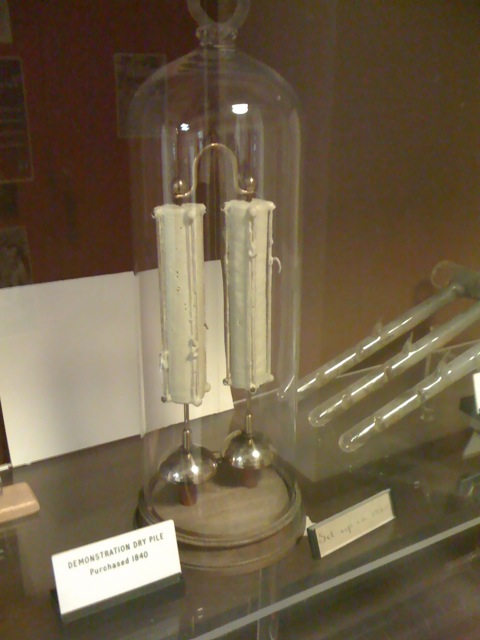
The apparatus comprises a metal sphere suspended between two dry pile batteries connected in series. As the metal ball moves endlessly back and forth between the cells, it receives alternating charges from one that repels it towards the other. Incredibly, this has been going on at least since 1840, presumably after someone flicked it into life
The device depends on electrostatic laws to keep it going. Hence, while it needs high voltage to create motion, the sphere only carries a small amount of electricity to the alternating dry piles. The custodian, Clarendon Laboratory at the University of Oxford thinks the apparatus dates from 1825.
The Smithsonian Institute’s Take on The Enigma

The Smithsonian Institute believes a clergyman-physicist, Robert Walker acquired the device in 1840. Since then, it thinks the Oxford Electric Bell may have rung over ten billion times. Is this perpetual motion? The Clarendon Laboratory says no. The ringing tone has become inaudible under the glass dome. The machine will stop when the sphere wears out, or the two dry piles hold equal charges.
The Smithsonian Institute agrees, however, it cannot investigate further because this would ‘ruin an experiment to see how long it would last’. It cites an opinion the piles ‘use alternating discs of silver, zinc, sulfur, and other materials to generate low currents of electricity’.
And so the enigma continues for now. We hope they leave the Oxford Electric Bell under its dome, when it finally rings for the last time. It will have worked faithfully all its life, reaching out to us from the past and the early days of science. What message do you think it tells?
Related
Experiment: Make a Voltaic Pile
Voltaic Pile: First Electrochemical Cell
Preview Image: Oxford Electric Bell


