Wikimedia Commons
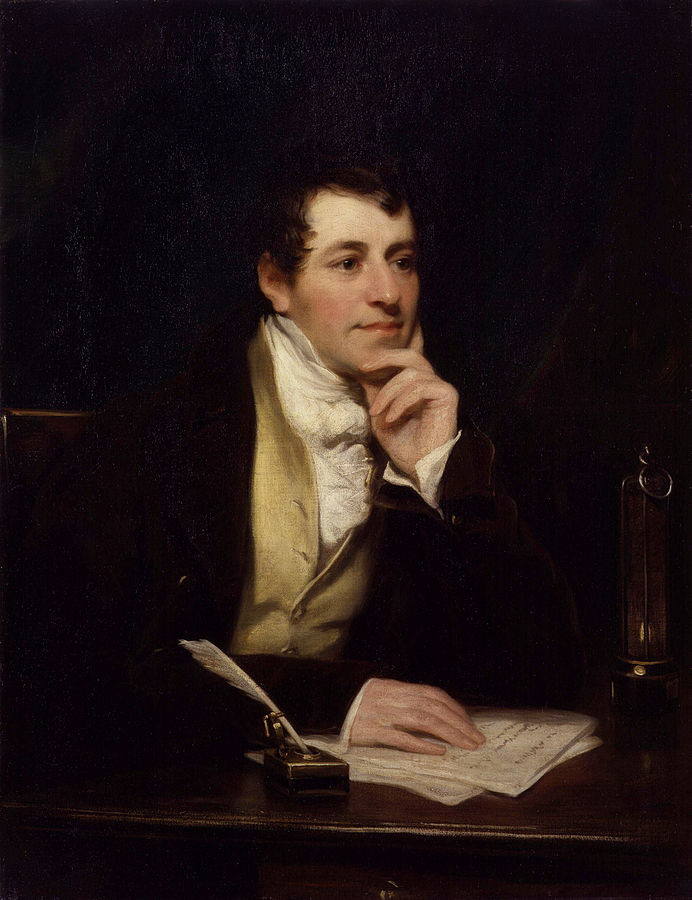
Humphry Davy was born on the 17th of December, 1778 in Penzance, near Cornwell, England. He attended grammar school but due to his father’s early death, Davy accepted an apprenticeship which he hoped would help prepare him for a career in medicine. Davy had a passion for poetry; he wrote poems himself and had a close association with renowned poets of the time such as Samuel Taylor Coleridge and Robert Southey.
As Davy commenced his serious scientific work, he was appointed as a chemical superintendent at the Pneumatic Institution of Bristol. He experimented a lot on gases, and his findings were published in 1800, in a well-received work entitled Researches, Chemical and Philosophical. He was called to serve as a lecturer at the Royal Institution, a position he accepted and relocated to London. Davy embarked on establishing an excellent equipped laboratory for carrying out his research, work that was partly funded by his salary and partly by Henry Cavendish and other distinguished scientists of the time.
Between 1806 and 1815, Davy conducted many groundbreaking experiments in the field of electrochemistry, continuing the work initiated by Anthony Carlisle and William Nicholson who managed to electrolyze water into elements oxygen and hydrogen. From his experiments, Davy managed to systematically electrolyze and isolate a number of elements such as potassium, sodium and some alkaline earth metals from their compounds. Davy successfully electrolyzed hydrochloric acid (Muriatic acid, as it was known at the time) into hydrogen and chlorine only, thus disapproving Antoine-Laurent Lavoisier’s theory that all acids contained oxygen.
Davy was also a talented lecturer who could get the attention of large audiences. Among the renowned scientists that Davy shaped is Michael Faraday. Working as a bookbinder at the time, Faraday chanced to attend one of Davy’s lectures; he was fascinated and wrote comprehensive notes which he later bound and sent to Davy together with a letter asking for a job. Davy considered his application and hired him as a laboratory assistant in 1812.
After his tour of Europe in 1815, Davy carried out a study to find out conditions that make methane explode in the presence of air. Through this experiment, he invented a miner’s lamp which became a great relief for the coal miners. This newly invented lamp ensured safety from fire accidents in the mines.
Aside from medals, Davy was also awarded a number of honors in his lifetime including the presidency of the Royal Society (1820-1827); Baronetcy (1818) and knighthood (1812).
Davy’s health became weakened due to exposure to chemicals. Like most of the chemists of his day, he was always at a risk, and during one experiment he almost died after inhaling water gas, a highly flammable gaseous mixture of carbon (II) oxide and hydrogen. By 1827, Davy was so weakened that he gave up some of the scientific posts he was holding. Davy’s health was deteriorated further by a stroke and on the 29th of May, 1829, he passed on leaving behind a widow and five children.
Related articles: