Scientists at Skolkovo Institute of Science and Technology in Moscow have learned to make batteries from organic materials. Working with Institute for Problems of Chemical Physics of Russian Academy of Sciences, and Ural Federal University has yielded results. That’s because the Skoltech scientists have found a new way that does not use lithium or other rare elements.
Skoltech Scientists Produce Impressive Stability and Density
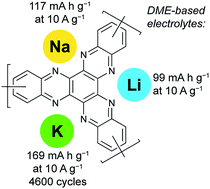
Furthermore, the multidisciplinary research team has demonstrated impressive stability of cathode materials. And also recorded high energy density in fast charge / discharge potassium-based batteries. However this has taken months to materialize.
Their initial paper described a polymer containing hexa-azatriphenylene fragments. This new material proved to be equally suitable for lithium, sodium and potassium batteries which charge in 30 to 60 seconds. While at the same time retaining their energy storage capacity after thousands of charge / discharge cycles. The Skoltech scientists second paper substituted this low-voltage model with a dihy-drophenazine-based polymer with higher operating voltage.
A Major Breakthrough Announced on November 11, 2019
In their third paper the scientists address the shortcomings of metal-ion batteries, especially metal anodes. They sought a way around dendrites and short circuits, and they believe they have found it in an organic battery.
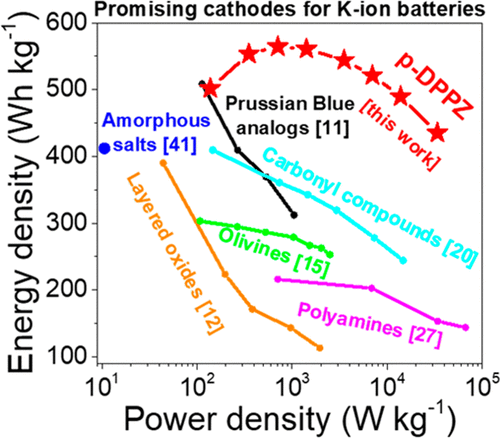
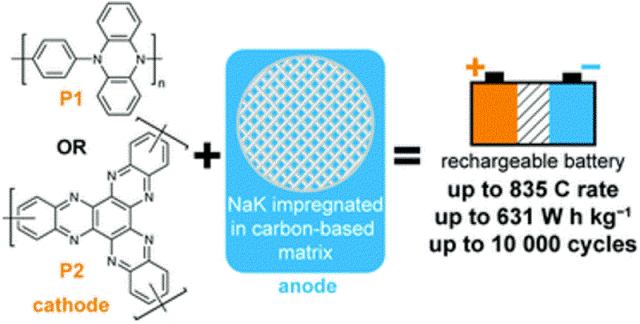
Their design uses a similar potassium-sodium alloy applied on carbon paper as anode. And the redox-active polymers obtained earlier as cathodes, however this time it charges and discharges in under ten seconds. One cathode was the highest capacity for potassium batteries. While the other lost just 11% after 10,000 charge / discharge cycles.
Moreover, both batteries displayed unrivaled power characteristics of nearly 100,000 W/kg. This is a level typical for super capacitors, the Skoltech scientists say. We shall follow this initiative and report back progress.
Related
Organic Radical Batteries for Sustained Energy
Low Temperature Batteries from Polymers
Preview Image: Skoltech Rechargable Battery