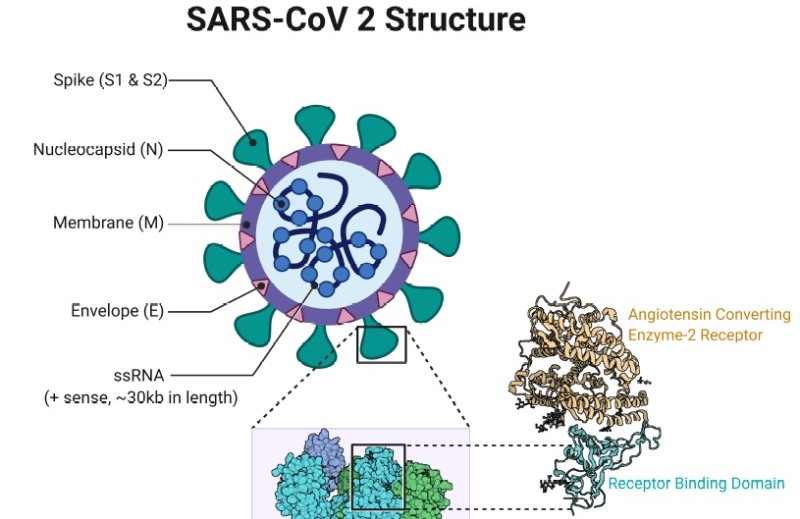
Most school kids know the COVID-19 spike protein enters through our enzyme portal ACE-2 cells. Research to date has largely aimed at preventing this embrace by targeting the invading spike protein. However, the virus is smart enough to constantly evolve and keep a jump ahead. Researchers may have found a new way of locking COVID-19 out with a fresh approach.
Tackling the Threat at the Ace-2 Enzyme Portal
Scientists at Weizmann Institute of Science teamed with colleagues at Pasteur Institute, France, and U.S. National Institutes of Health. What if, they wondered we could evolve something new, and create a ‘super cork’ that jammed the Ace-2 entry port? Could this mean the evolving coronavirus would be tightly locked out?
Locking COVID-19 out by slamming the door shut is not an entirely new idea. However, on this occasion the researchers evolved a practical way to do so. They created a small protein molecule able to bind to the ACE2 gateway better than the SARS-CoV-2 virus. Effectively locking it out, but without affecting the receptor’s enzymatic activity.
Stealing a March on the Coronavirus Spike Protein
The researchers isolated the spike protein building blocks first, which enable it to physically bind to the ACE-2 enzyme receptor cells. Then they evolved this block through several stages to a genetically engineered strain of baker’s yeast.
Baker’s yeast is pliable. And so the team could scan millions of mutations rapidly. until they spotted the small molecule they needed. This was a group of atoms even ‘stickier’ than the original spike protein.
The modified baker’s yeast has significantly reduced symptoms in hamsters infected with the virus, they told Sci Tech Daily August 27, 2021. More pre-clinical studies will begin at U.S. National Institutes of Health ‘in the near future’.
Recent
Obesity and COVID-19 Make a Deadly Team
Immunity Continues After Vaccinations Wane
Preview Image: The SARS-CoV-2 Virus