

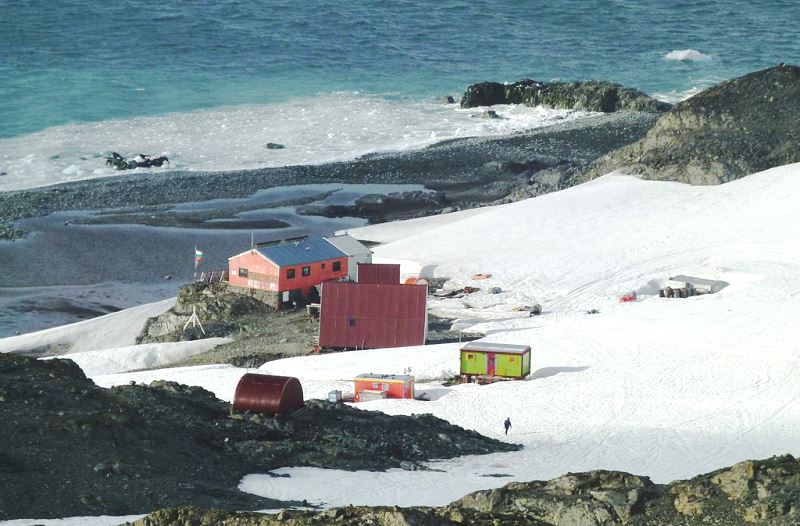
The South Slavic, East European nation of Bulgaria maintains the St. Kliment Ohridski Base on Livingston Island in South Shetlands. This is a harsh frozen landscape of polar tundra 22 miles long by 45 miles wide, visited almost entirely by scientists. The Bulgaria base where Antarctic lead batteries probe climate change is a short distance inland from where it overlooks a lagoon.
The Purpose of Bulgarian Research on Livingston Island
Bulgarian scientists established a foothold on Livingston Island in 1988, when they landed with two prefabricated huts. First they worked there on an ad hoc basis supported by Soviet Research Ship Mikhail Somov. And then in 1993 they refurbished the facilities and established a semi-permanent presence.
Energy for the project comes exclusively from solar panels via 80 lead acid storage batteries. These power research equipment, heating, and cooking food. The ambient temperature outside the huts falls as low as -22.4 F in July. However, the scientists can continue their work powered by this clean renewable energy.
The Antarctic Climate Change Probe on Lead Battery Power.
Three geologists regularly snow mobile out across the frozen waste to a tent camp. There they collect numerous fossils, and ore minerals during the week that follows. But they also retrieve data from eight robots and three series plotters in a collaboration with Portuguese scientists.
This equipment collects time-based data concerning temperature, pressure, humidity, solar radiation, altitude, and GPS location. And this in turn helps scientists all over the world assess steady progression into global warming.
However, none of this work would be possible without abundant solar power and rechargeable lead acid batteries. We therefore imagine those scientists are aware of the bigger picture as their Antarctic lead batteries help them probe climate change.
Will the climate in which they survive become the new normal if climate change continues? Could a new ice age steadily spread south from the Arctic Circle? It did several times before, you know. And another climate shift could have this on the cards again.
Previous Posts
Lead Acid Battery Plates at the Heart of Energy
Further Advantages of Batteries in Freight Cars
Preview Image: Base Camp on Livingston Island


