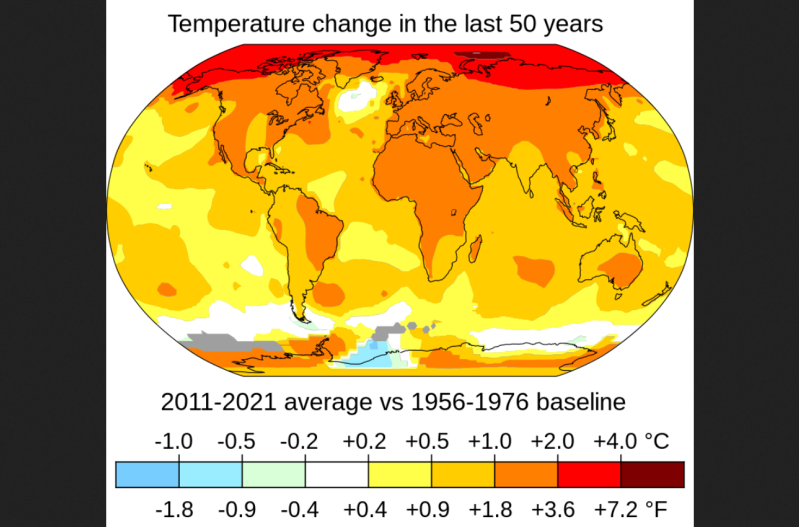
Could climate change cause our extinction? Are we marching lemming-like towards an abyss? A team affiliated with Centre for the Study of Existential Risk at University of Cambridge believes we are not taking catastrophic climate changes seriously enough. They say the consequences of extreme warming are ‘dangerously unexplored’.
The Climate Change End Game Before Extinction
The Cambridge team say we need to start preparing for the ‘climate change end game’, according to BBC Science on August 2, 2022. According to them, the closest we have come to this is not mainstream science. We have to look in science fiction books such as The Uninhabitable Earth by David Wallace-Wells.
That because climate scientists have tended to focus on global warming reaching 1.5C to 2C above temperatures in 1850. That was before the onset of the Industrial Revolution, and large-scale burning of fossil fuels. Those studies do acknowledge ‘the heavy burdens on global economies’ but stop short before the end of humanity.
There were good reasons for this at the time, the team from Centre for the Study of Existential Risk at University of Cambridge believes. The first of these was the Paris Climate Agreement to keep warming well below 2.0C. And the second was the consequential belief we therefore did not need to look further into the abyss.
We Need to Consider to More Extreme Outcomes
Lead author Dr. Luke Kemp from University of Cambridge was to the point when he spoke to BBC Science. “I think it is sane risk management to think about plausible worst-case scenarios,” he explained. “We do it when it comes to every other situation, we should definitely do when it comes to the fate of the planet and species,”
The researchers calculated by 2070, 2 billion people living in some of the most politically fragile areas of the world will be enduring annual average temperatures of 29C. The political consequences will directly affect two nuclear powers. And seven maximum containment laboratories housing the most dangerous pathogens.
“There is serious potential for disastrous knock-on effects,” Dr. Luke Kemp believes. “Focusing on the worst-case scenarios could help inform the public. Understanding these plausible, but grim scenarios is something that could galvanize both political and civil opinion.”
Breaking News
Are We Doomed to Keep Repeating History?
Are COVID and Climate Change Interrelated?