If we do the right thing in isolation, but trash every ethical principle in the process, then what do we achieve? That argument is sometimes at the heart of those who believe manufacturing batteries does more damage than burning gasoline fuel. A European study compared batteries versus oil in terms of raw material impact, and declared batteries the winner.
A Comprehensive Overview of Batteries Versus Oil
The study was commissioned by European Federation for Transport and Environment in 2021, and we link to it below. In overview terms, this report assesses the net amount of raw materials currently needed to make electric vehicle batteries. However, the study also factors in the following:
- How it expects battery design will become more efficient in terms of demand on materials.
- How it expects extraction of raw materials will reduce, as more battery materials are recycled.
These factors are important, because until quite recently there was more emphasis on increasing battery capacity and power.
Key Findings in This Ground Breaking Study
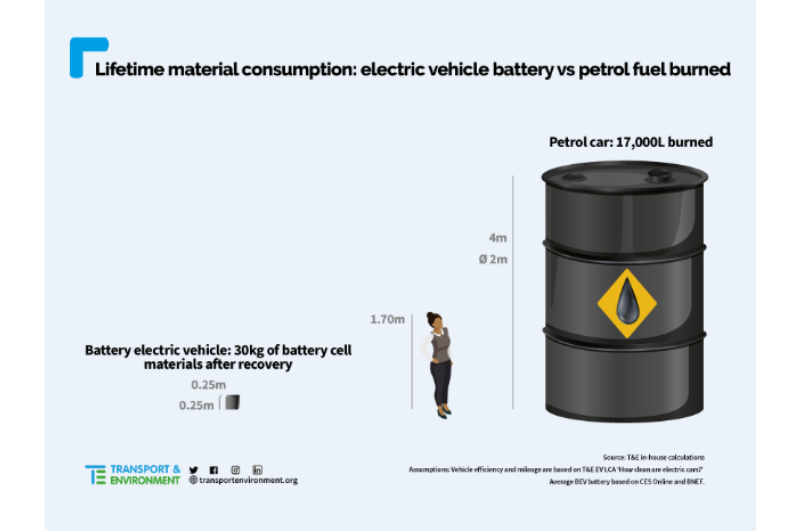
- Transport and Environment calculated how much battery metal is ‘lost ‘during the life time of an electric vehicle’. It concluded that the unrecycled bulk is currently ‘about the size of a football’.
- The report estimates that an average internal combustion vehicle would burn ‘close to 17,000 liters of petrol’ during its lifetime. This would be ‘equivalent to a stack of oil barrels 300 hundred feet high’.
- Technological advancements should reduce the bulk of battery metals further. For example, the report suggests that the amount of lithium in a lithium battery will halve in the course of the next decade.
Therefore, and this was a key focus in the study, Europe will need to import less lithium battery material in future. Although it will still be highly dependent on imports, unless it replaces this particular chemistry.
More Information
Electric Truck Battery Second Lives
The Search for Better Battery Materials