Manganese is a hard, brittle, silvery metal useful as transitional material in strengthening and hardening iron. It has many other manufacturing uses. But perhaps most interesting of all, it helps plants produce oxygen, while being essential in human diets. But now lithium battery scientists are using it in lithium manganese cathodes too.
Why the Renewed Interest in Lithium Manganese Cathodes ?
Well first of all, manganese is cheaper to mine and more abundant than lithium. Much lithium also comes from mines in Democratic Republic of Congo, where there are questionable labor practices.
Manganese batteries continue to attract interest of scientists as potential alternatives to lithium-ion batteries. Although lithium used alongside cobalt and nickel still leads with high conductivity as cathode.
But nowadays we also find manganese in lithium-ion battery cathodes. Martin Kepman is chief executive officer of Canadian manganese mining company Manganese X Energy Corporation. He explains the role of manganese to Euro News Business as follows:
“Manganese is a candidate for disruption in the lithium-ion battery space. It has elemental qualities that have the potential to improve density, capacity, rechargeability, safety and battery longevity. The timing for establishing a North American manganese resource could not be better.”
Two Examples of Lithium-Manganese Blends
Let’s take a look at two types of these cathodes to understand how this could work in practice:
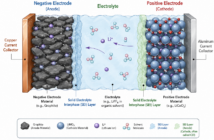
A lithium-ion manganese-oxide battery uses manganese-dioxide as its cathode. This provides a relatively-cheap solution, that is also less toxic, less flammable, and more thermally stable.
However, and here’s the potential problem, lithium-ion manganese-oxide batteries degrade quite rapidly at their cathodes. Notwithstanding this, the potential for high capacity storage is there.
For these reasons, there is currently greater interest in lithium nickel manganese cobalt oxide cathodes. This combination is particularly attractive, because of the scope for enhanced electric vehicle performance.
Furthermore, adding the nickel increases capacity while promoting stability. Many electric cars already use this combination in their batteries, as well as do numerous laptops and smartphones.
More Information
Lithium-Ion Manganese Oxide Longevity