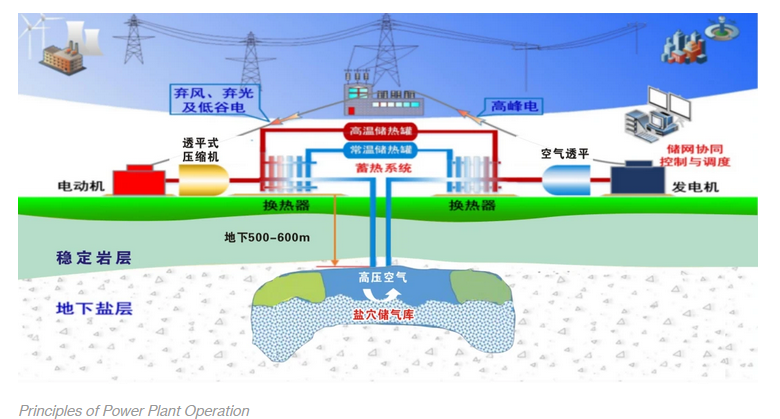
Compressed-air storage is a way to reserve electrical energy for future use. We compress the air in a storage vessel using electricity. When we need the electricity later, we use the compressed-air to drive a turbine. Western electricity utilities seem hardly interested. But when China commissions 300 megawatts of compressed-air storage in Yingcheng, perhaps that’s another story.
China’s Largest Compressed–Air Storage in Yingcheng
The State Council of The People’s Republic of China lead with the news of compressed-air storage in Yingcheng, on January 12, 2025. Their announcement was short and to the point as follows:
“A compressed–air energy storage (CAES) power station in Yingcheng City, central China’s Hubei Province, was successfully connected to the grid at full capacity on Thursday, marking the official commencement of commercial operations for the power station.”
The Energy Storage & Smart Energy (ESTEC) website was quick to take up the news, and we acknowledge our use of their image with thanks. ESTEC confirms that the groundbreaking 300MW / 1,500MWh project has begun full operation.
This innovative initiative should be able to help support Yingcheng City for 5 hours. It leverages the bulk storage potential of an abandoned salt mine, and completed within two years. This was 3 – 4 times faster than building a pumped hydro power station, per China Energy Engineering Corporation.
A Key Pillar for Building a New Power System
China Daily describes the compressed-air storage system as a key pillar for building a new power system. The official name of the newly-commissioned power station is Nengchu-1, and we shall not be surprised if others follow.
Nengchu-1’s annual capacity is 500 million kilowatt-hours of electricity. The project will save more than 150,000 metric tons of standard coal each year. Through it, we begin to glimpse the immense, untapped potential of compressed-air energy storage.
More Information
Compressed Carbon-Dioxide Storage Battery