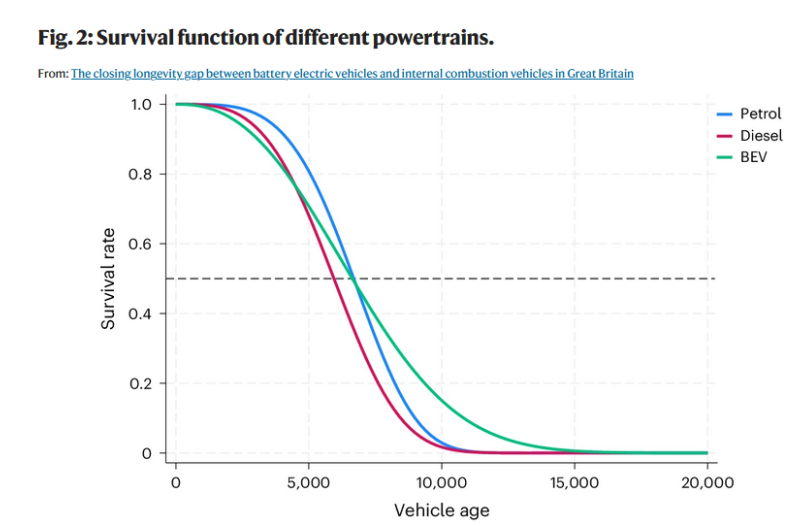
Early battery electric vehicles (EVs) were less reliable than internal combustion engines (ICE), and did not last as long. Researchers at University of Birmingham, London School of Economics, and University of California, conclude that this situation has subsequently reversed. They established that modern EVs close the longevity gap, after they examined 264 million annual UK roadworthy (MOT) tests.
The Historical Longevity Gap Between EVs and ICE
The researchers concede that early battery electric vehicles ‘exhibited lower reliability than internal combustion engine vehicles’ (refer to research report below). And that this in turn convinced the general motoring public that battery electric vehicles were a ‘bad buy’.
However, since then, ‘rapid technological advancements’ have allowed EVs to achieve comparable lifespans, even if used more intensely. This trend reinforces the case for converting to electric from gasoline transport, especially now longer EV life compensates for their carbon-intensive manufacture.
International leasing and fleet management company Arval, has an interest in the lifetime of electric vehicles too. We understand from Global Fleet that they independently found the following:
- EV’s that covered 45,000 miles and were ‘end of lease’, still retained 93% of original battery capacity.
- And even after they had traveled 125,000 miles, EV’s still retained 90% of original battery capacity.
EVs Close The Longevity Gap Despite Battery Degradation
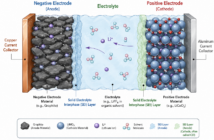
We now know that lithium-ion battery performance declines in a non-linear direction. In other words, they have an initial capacity drop, whereafter their energy storage ability falls away far more gradually. And then, towards the end of their useful life, their capacity decreases rapidly again.
The study by University of Birmingham, London School of Economics, and University of California researchers, confirms the Global Fleet conclusion. The sheer numbers in their research are sufficient to persuade us to take their findings seriously:
- 264 million test results for the period 2005 to 2022.
- Representing a population of 8 million vehicles.
- These numbers exclude 371,000 hybrid EV’s.
There is therefore solid evidence that modern EVs close the longevity gap, and will last even longer than gasoline in future. Yet, despite this, their poor early performance lingers, and many skeptics remain.
More Information
The Power of Second Life EV Batteries
Dynamically Extending Battery Lifetime in EVs