

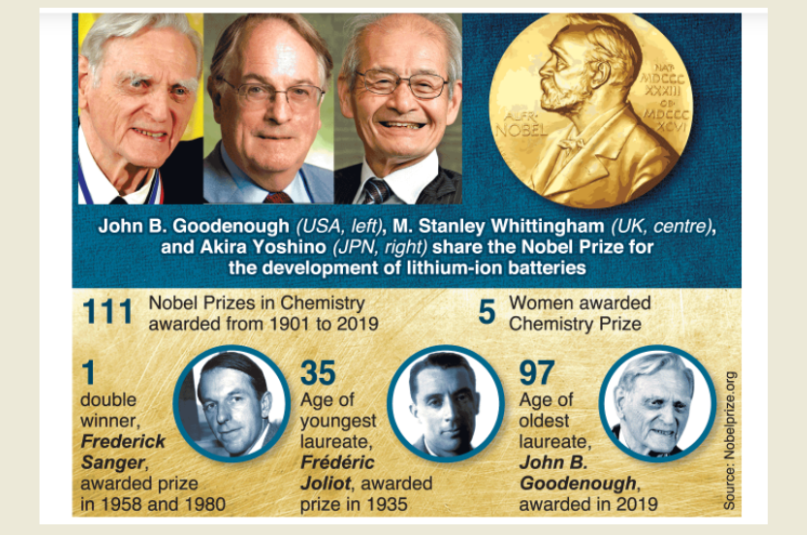
Lithium-ion chemistry has made a dramatic difference to our lifestyles, by storing more energy per unit of weight. The occasional fires that faulty lithium-ion batteries leave in their wake, have not dented consumer enthusiasm. Many armchair readers believe John Goodenough came up with the idea. But who developed the lithium-ion battery, really?
The Early Development of Lithium-Ion Chemistry
The earliest research dates from the 1960s. NASA experimented with copper fluoride lithium chemistry in 1965, but found the performance disappointing.
M Stanley Whittingham discovered intercalation chemistry in 1974. This allowed ions to store in layered titanium-disulfide cathodes, without changing their crystal structures. Whittingham was working at Exxon Mobil at the time.
Exxon tried to commercialize Whittingham’s model a few year’s later, but found titanium-disulfide too expensive to synthesize. It also released toxic hydrogen sulfide in contact with water. Besides, the metallic lithium was prone to catching fire spontaneously.
Three Researchers Working Separately Make Progress
However, the work continued in various laboratories, that kept their progress under wraps until they had something solid to patent. And so it was that Ned A Godshell, Koichi Mizushima, and John B Goodenough almost simultaneously replaced the titanium-disulfide with lithium cobalt oxide in 1980.
This modification worked to an extent, although the lithium-metal anodes in rechargeable versions were unstable. They soon formed dendrites that short-circuited their cathodes. The focus shifted to using intercalating anodes, to prevent lithium metal forming during battery charging.
Akira Yoshino achieved a breakthrough in 1985, when he discovered that petroleum coke reversibly intercalated lithium-ions. His finding opened the door to commercial lithium-ion batteries, even though the coke stored less energy than graphite.
None the less the debate continued, over who developed the lithium-ion battery first. In 2019, the Nobel Foundation awarded the Nobel Prize in Chemistry jointly to Godshell, Mizushima, and Yoshino, “for their contributions to the development of the lithium-ion battery”.
More Information
M Stanley Whittingham Father of Intercalation
Akira Yoshino Father of Lithium-Ion Batteries
Preview Image: Winners of 2019 Chemistry Prize
High Density Primary Batteries NASA 1966
Energy Storage and Intercalation (Whittingham, 1975)
Research by Ned A Godshell May 1980.


