We know we need to build batteries without using scarce and costly cobalt, nickel and copper. Today we present a new development, which is building batteries with pistachio nut shells. While this may sound absurd at first, the idea is real and it works!
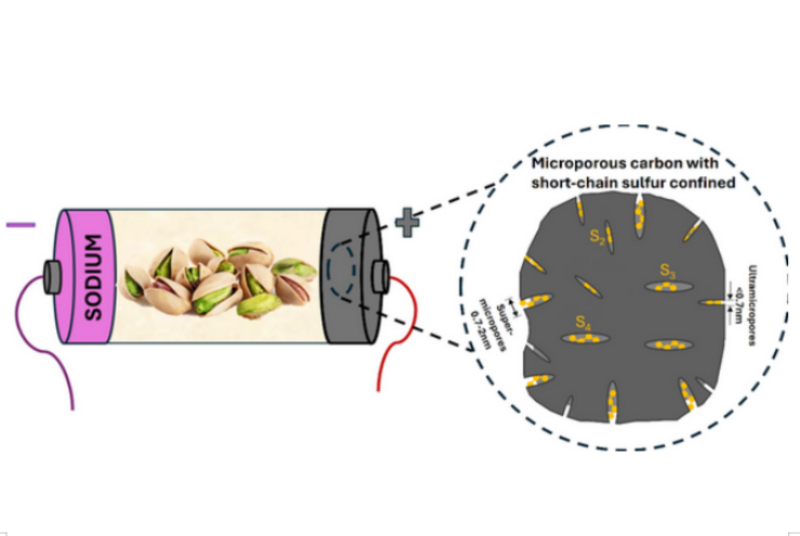
The new development generates porous carbon from pistachio nut shells as follows:
- The pistachio shells are converted into active carbon biomass.
- The battery uses sodium and sulfur as its active materials.
- While the nut biomass acts as a conductor in the system.
This blend produces a battery that does not require scarce and costly cobalt, nickel or copper.
Why Build Batteries With Pistachio Nut Shells?
That’s a great question, because pistachio nuts may have been around for as long as humans. However, sales of these tasty treats have been booming, since they became popular ingredients in desserts, chocolates, candy, ice cream, and as a paste or butter.
Global pistachio nut production reached an astounding 1.4 million tons in 2024, according to Wikipedia. The main producers are United States, Iran and Turkey, and of course Spain too. However, with popularity comes the problem of what to do with the waste shells.
Building batteries with pistachio nut shells is therefore not just a scientific curiosity. It also presents a strategic solution for what to do with some of this non-toxic, biological waste. Let’s move on and discover how this idea works in practice in batteries.
Role of Pistachio Shells in Battery Anodes
Graphite (carbon) electrodes have high conductivity and ion storage capacity, and have a long cycle-life too. The researchers at University of Córdoba in Spain, produced a carbon biomass alternative by exposing the waste shells to high heat.
This produced an excellent activated carbon, which acted as the conductive mix in a sulfur battery. The capacity was around 650 milliamp-hours per gram, with high retention for the first 300 cycles, according to a report by MDPI.
More Information
Palm Oil Biomass Stop-Gap Energy Source
Biochemical Conversion of Biomass into Energy
Preview Image: Nut Waste in Sulfur Battery