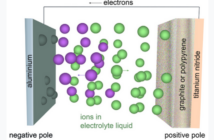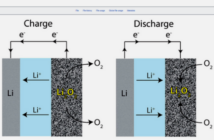
One way to visualize intercalation in battery chemistry, is to imagine a multistory parking garage with hundreds of empty spaces. Cars can park there, and later leave without damaging the building.
Intercalation is the process whereby tiny charged particles called ions, move into spaces within solid materials, and later move back out again.
The host material retains its original structure. It does not significantly change, and so the process can repeat many times.
Intercalation in Lithium-Ion Battery Chemistry
Intercalation occurs in some batteries, although not all. The rechargeable lithium-ion battery is one familiar example:
- Lithium ions leave one electrode and travel through the electrolyte to the other electrode during charging.
- They slip into microscopic spaces between layers of atoms in the electrode material as they arrive.
- The ions then reverse direction, and return to their original electrode during discharging.
Intercalation in battery chemistry allows electrodes to store and release energy repeatedly without major chemical damage. This is how lithium-ion batteries can power phones, laptops, electric vehicles, and energy-storage systems through many charge-and-discharge cycles.
A Broader View on Battery Intercalation
But intercalation is not limited to lithium-ion batteries. Sodium-ion batteries and several other rechargeable battery technologies also rely on the same principle. The main difference is the type of ion that moves in and out of the host material.
To summarise at this point, intercalation in battery chemistry is the reversible insertion and removal of ions in solid electrodes. This makes long-life rechargeable batteries possible.
Another way to think about intercalation, is as a compromise between simple storage and full chemical reactions. The ions are not merely sitting on the surface, nor permanently altering the host material.
The ions are temporarily within the material’s structure, and can later leave again. This ability to move in and out repeatedly is a major reason why lithium-ion, and soon sodium-ion batteries have become so successful.
More Information
Predicting Lithium Intercalation Rates