A rechargeable battery has one great advantage over a single-use battery cell. It can be used many times over. The secret lies in how rechargeable batteries return ions for re-use, reversing a previous chemical reaction.
Returning Ions That Moved From One Electrode To The Other
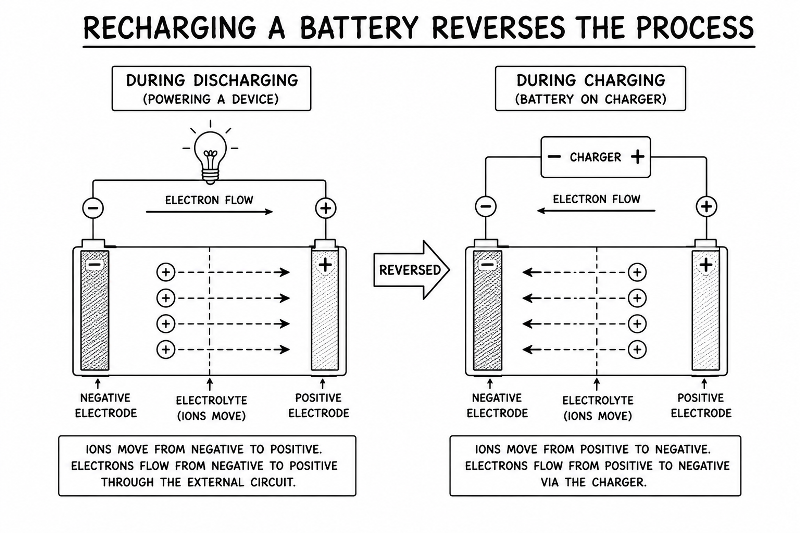
Recharging a suitable battery reverses the process, whereby ions moved from one electrode to the other during discharging. While at the same time, electrons moved in the opposite direction via the terminals.
Returning ions move back from one electrode to the other again, while electrons flow in from the battery charger. This is how rechargeable batteries gradually return their ions, and reinstate their spent chemical energy.
Recharging Batteries Gradually Reverses The Electron Journey Too
A charger pushes electrons back into the battery from the opposite direction. At the same time, the ions slowly move back to their original positions through the electrolyte.
Steadily, Rechargeable Batteries Get Their Energy Back
Little by little, the battery’s chemicals return to the condition they were in, before the battery was last used. When charging is complete, the battery is ready to supply new electricity once again.
This cycle of discharging and charging can be repeated hundreds or even thousands of times, depending on the battery chemistry and how the battery is used.
Nothing Lasts Forever, Not Even The Ions In Batteries
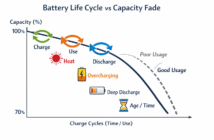
This may well be how rechargeable batteries return ions, but eventually every rechargeable battery wears out. Tiny changes inside the materials reduce the number of ions that can move freely.
As a result, the battery stores less energy than it did when it was new. That helps explain why an old phone battery needs charging more often than a new one.
Time to Move on To Discussing Different Battery Chemistries
In our next article we share why so many different battery chemistries exist, and why no single battery is perfect for every job. One size does not fit all!
More Information From Our Battery Blog