A lead-acid battery may appear unchanged from outside of its case, as it charges and discharges. However, ions and active materials are constantly changing inside. Would you like to learn more about how ions change lead battery plates? Then read on.
The Ions Come From The Sulfuric Acid Electrolyte
Lead battery electrolyte contains diluted sulfuric acid. This provides ions for the battery’s chemical reactions, which vary as it discharges and recharges.
As The Battery Discharges Ions Move To The Plates
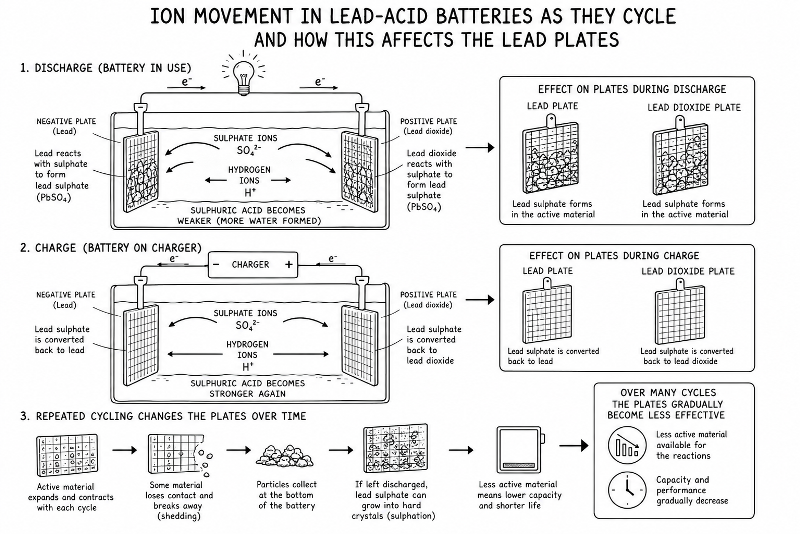
As the battery sends electricity through a circuit, sulfate ions move through the electrolyte towards both plates.
Lead reacts with sulfate at the negative plate, and forms lead sulfate. Meanwhile, lead dioxide reacts with sulfate at the positive plate, and forms lead sulfate.
These two reactions produce electricity. They also consume some of the sulfuric acid, so the electrolyte becomes less concentrated.
The Ions Are Not Just Moving. They Are Chemically Active
The ions are therefore not simply traveling from one plate to the other. They are taking part in chemical reactions at the plate surfaces.
As The Battery Charges It Reinstates The Battery
A battery charger supplies electricity that drives the reactions in the opposite direction. Lead sulfate on the negative plate converts back towards lead. While this happens, the positive plate returns to lead dioxide.
Sulfate returns to the electrolyte, increasing its sulfuric acid concentration back to its original state.
However, Nothing Is Perfect -The Battery Slowly Degrades
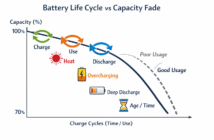
So that is how ions change lead battery plates and reverse the process? That is correct in principle but no battery lasts forever! The process is not perfectly reversible.
The active material on the plates repeatedly changes chemical form during each cycle. This causes the plates to expand and contract.
Over many cycles, some material can lose contact with the plates and break away. This is called shedding. The loose material can settle at the bottom of the battery.
Lead sulfate can form larger, harder crystals that are difficult to convert during charging, if the battery remains deeply discharged. Eventually, less active material remains available for the chemical reactions. The battery then loses capacity and performance.
More Information From Our Battery Blog