Every important battery has a history of problems behind it. Engineers rarely begin with a perfect design. They discover weaknesses through experiments, testing and sometimes failures. We close this series with what battery failures taught engineers.
Producing Electricity Was Only The Beginning …
Early batteries taught engineers that producing electricity was only the beginning. Volta’s pile demonstrated that chemical reactions could provide a continuous electrical current.
But it suffered from drying, leakage and chemical buildup. Later designs addressed these weaknesses with different materials and construction methods.
Lead-Acid Batteries Provided Rechargeable Power …
Lead-acid batteries provided rechargeable power but brought their own challenges. Engineers spent decades improving plates, grids, separators, charging methods and manufacturing techniques.
Each improvement came from understanding why earlier designs deteriorated or failed. This is a further example of what battery failures taught engineers.
The Same Pattern Continued With Other Chemistries …
The same pattern continued with other chemistries. Nickel-iron batteries demonstrated that a rechargeable battery could be exceptionally durable. Even though their weight, efficiency and other characteristics limited some applications.
Early electric vehicles showed that a good motor could not overcome inadequate battery range and charging convenience.
Lithium-Ion Batteries Taught Us Another Lesson …
Lithium-ion batteries brought another lesson. High energy density created its own engineering responsibilities. Fires and thermal-runaway incidents showed the importance of separators, temperature control, protection circuits and careful manufacturing.
Failures Became a Source Of Engineering Knowledge …
Battery failures became a source of engineering knowledge. A battery that overheated could reveal a weakness in its materials.
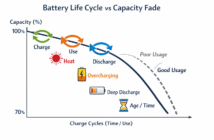
Batteries that lost capacity could show where their electrodes were deteriorating. A battery that failed after repeated charging could point to changes taking place inside the cell.
Battery Development Relies On Accumulated Experience …
Modern battery development depends heavily on this accumulated experience. Engineers do not simply ask how much energy a new battery can store. The history of batteries is a history of learning from failure.
More Information
Are Electric Vehicle Batteries Sustainable Yet?
A Sulfur Composite Battery with 3 Times Higher Energy Density