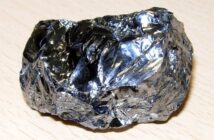
An unusual iridescent material, that has puzzled physicists for decades, turns out to be an exotic state of matter that could open a new path to quantum computers and other next-generation electronics.
University of Michigan physicists have discovered or confirmed several properties of the compound samarium hexaboride, which raises hopes for finding the silicon of the quantum era. They say their results also close the case of how to classify the material, a mystery that has been investigated since the late 1960s.
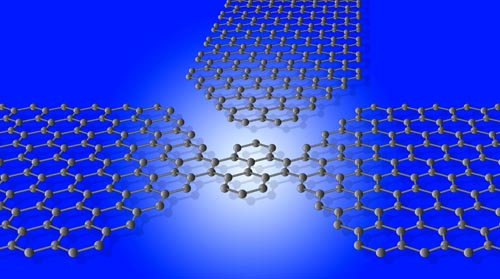
The researchers provide the first direct evidence that samarium hexaboride, abbreviated SmB6, is a topological insulator. Topological insulators are a class of solids that conduct electricity like a metal across their surface, but block the flow of current like rubber through their interior. They obtain this quality even though their chemical composition is the same throughout.
The scientists at U of M used a technique called torque magnetometry to observe tell-tale oscillations in the material’s response to a magnetic field that reveal how electric current moves through it.
Their technique also showed that the surface of samarium hexaboride holds rare Dirac electrons, particles with the potential to help researchers overcome one of the biggest hurdles in quantum computing.
Scientists believe these properties are particularly enticing because SmB6 is considered a strongly correlated material. Its electrons interact more closely with one another, than most solids. This helps its interior maintain electricity-blocking behavior.
This deeper understanding of samarium hexaboride raises the possibility that engineers might one day route the flow of electric current in quantum computers like they do on silicon in conventional electronics, said Lu Li, assistant professor of physics in the College of Literature, Science and the Arts and co-author of a paper on the findings published in Science.
“Before this, no one had found Dirac electrons in a strongly correlated material,” Li said. “We thought strong correlation would hurt them, but now we know it doesn’t. While I don’t think this material is the answer, now we know that this combination of properties is possible and we can look for other candidates.”
The drawback of samarium hexaboride, is that the researchers only observed these behaviors at ultracold temperatures.
Quantum computers use particles like atoms or electrons to perform processing and memory tasks. They could offer dramatic increases in computing power due to their ability to carry out scores of calculations at once. Since quantum computers can factor numbers much faster than conventional computers, they would greatly improve computer security.
While these benefits are intriguing, the researchers are enthusiastic about the fundamental science they’ve uncovered.
“In the science business you have concepts that tell you it should be this or that and when it’s two things at once, that’s a sign you have something interesting to find,” said Jim Allen, an emeritus professor of physics who studied samarium hexaboride for 30 years. “Mysteries are always intriguing to people who do curiosity-driven research.”
At UPS Battery Center, our goal isn’t to only sell batteries, we want to inform and teach you about the amazing world of batteries, electricity and energy. Please check back for more interesting, helpful and informative articles about batteries and electricity.
Related Articles:
Superconducting Computer Chips with Increased Energy Efficiency
Scientists Invent Spray on Solar Cells
The Second Law of Thermodynamics