Lithium-ion batteries are often at the heart of portable electronic devices, grid storage, and electric vehicles. We really could not do without them at this stage, although we are concerned about the cobalt metal they contain. Elhoucine Elmaataouy from Mohammed VI Polytechnic University in Morocco, proposes a novel, cobalt-free lithium-ion battery cathode that eliminates the metal completely.
Why Should Lithium-Ion Batteries Be Free From Cobalt?
There are two main issues to consider here, advises Elmaataouy. His two concerns are the cost of the metal, and the fact that it is toxic to the environment. There are also ethical concerns about working conditions in some cobalt mines, in the Democratic Republic of Congo.
The global battery industry is aware of these issues. Lithium-ion battery manufacturers have steadily reduced cobalt from 2010 onward. Morocco World News believes this strategy has resulted in a 90% reduction in cobalt content, through using alternative materials.
The young Moroccan scientist has revisited the possibility of using lithium nickel oxide in lithium-ion battery cathodes. This material offers high capacity at an average working voltage. However, earlier work has not resulted in a viable cobalt-free lithium-ion battery, due to declining performance.
The Cobalt Substitute Proposed by Elhoucine Elmaataouy
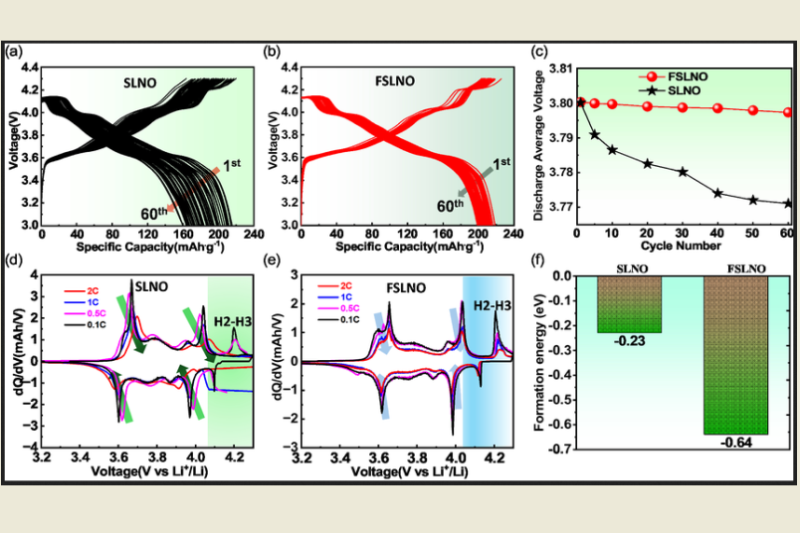
Elmaataouy has developed a novel way to achieve a cobalt-free lithium-ion battery cathode, by substituting doped lithium nickel oxide:
- First, he prepared a single particle of lithium nickel oxide, that he doped with fluorine to coat it.
- Then he stabilized this outcome in a high-temperature, high-pressure aqueous solution, assisted by ball milling.
- The ball milling process, using grinding media in a rotating cylindrical vessel, compacted the particle.
The strategy of using a fluorine-doped lithium nickel oxide particle, delivered a workable lithium-ion battery cathode. It coped well with the discharging / recharging process, retaining 90% of its capacity after 60 cycles.
More Information
Will Fluorine Open a Lithium Life Extension Gap?
Stabilizing High-Nickel Cathodes For L-Ion