COVID-19 is most infectious in early stages of the disease, according to a paper in the Lancet Microbe journal. This new study appeared on November 19, 2020, and again proves the importance of early contact tracing. The researchers (see link below) say people are also most likely to pass the infection in the first 5 days. Moreover this period, as we know coincides with the phase of self-denial.
Factors Influencing Peak Infectiousness in Virus Carriers
First, the team from Saint Andrews University in Fife Scotland revisited over seventy global studies of people showing symptoms. Then they found researchers had been able to clone surviving virus up to 9 days after infections started. But they also found the virus was most widespread in infected people’s throats, for the first five days after symptoms showed.
Notwithstanding this, inactive fragments were still present in their throats and noses up to 17 days after the disease began. The researchers however concluded the high infection risk starts winding down after the 9 day period. And Dr. Muge Cevik of University of St Andrews assured BBC this is in line with other studies involving contact tracing.
Implications of COVID-19 Being Most Infectious in Early Stages
This confirmation that COVID-19 is most infectious in early stages of the illness, reinforces the need for universal masking. That’s because it is increasingly evident unprotected, infectious people are roaming cities going about their daily business.
Moreover, they could be asymptomatic; they also could be symptomatic in early denial. Therefore we have to protect ourselves, because some of them are unwilling to do so. The St Andrews research team concludes its study by remarking. ‘These findings highlight that isolation practices should commence with the start of first symptoms, including mild and atypical symptoms that precede more typical COVID-19 symptoms.
‘However, given potential delays in the isolation of patients, effective containment of SARS-CoV-2 might be challenging, even with an early detection and isolation strategy.’
Related
Infectious Diseases, Viruses and Bacteria
Infectious Diseases and How Infection Works
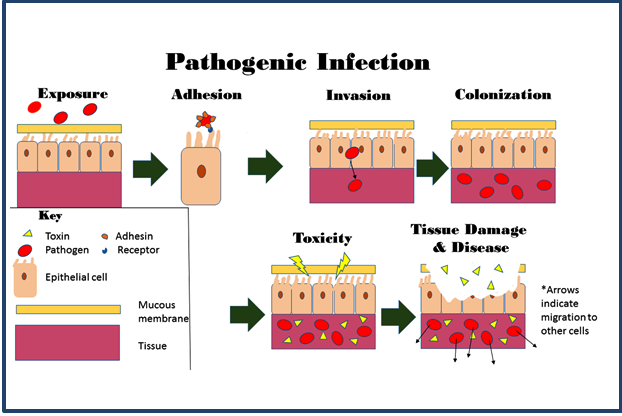
Preview Image: Pathogenic Infection