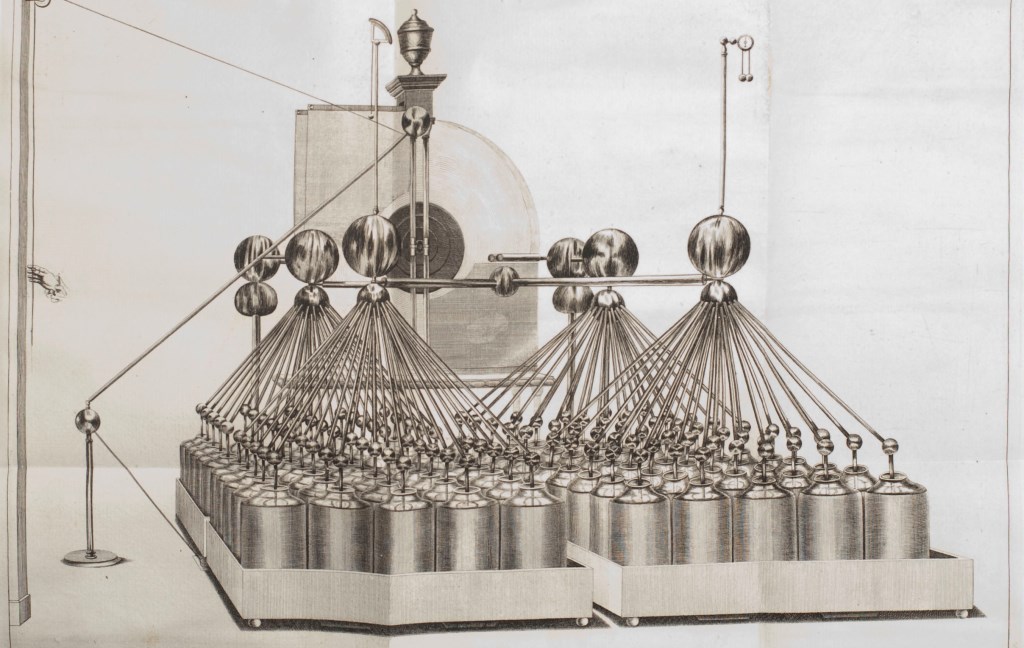
We use the word ‘battery’ to refer to a collection of associated objects working together. Hence soldiers speak of a battery of artillery pieces, while solicitors use a battery of arguments to prove their cases. Both Volta and Leyden used sets of cells in their early experiments. We don’t know how electric batteries received their name. Perhaps someone said “that looks like a fortress bristling with canons”.
How Electric Batteries Received Their Labels
It wasn’t long before everybody seemed to want to make money from the new science of portable electricity. Various types of chemistry appeared, and there were different sizes for different applications. Soon, ordering a battery could produce all kinds of surprises.
In 1906 the French government had had enough of the chaos. We don’t know how electric batteries received their name, they may have said. But we need a commission électrotechnique international to sort this out. They tasked their international electronic commission with setting standards for a wide range of electrical products. A typical IEC battery label reads LR2616J denoting cell numbers, chemistries, shapes, dimensions etc.

The Elegantly Simpler American ANSI Standard
The U.S. National Bureau of Standards began regulating batteries in 1919. It revised its battery of ANSI standards several times to adapt to new cells and technologies. The 1928 edition listed cell sizes using an alphabetic code plus an additional No. 6 cell for the first time.
However, from 1984 onward ANSI standards gradually began to harmonize with IEC names in terms of detail provided. Hence, the U.S. National Bureau of Standards added codes for size and shape, and later chemical composition and performance characteristics too. Thus a CR2032 cell has a relatively higher discharge rate, a 20mm diameter, and a 3.2mm thickness. The chemistry type appears elsewhere on the case.
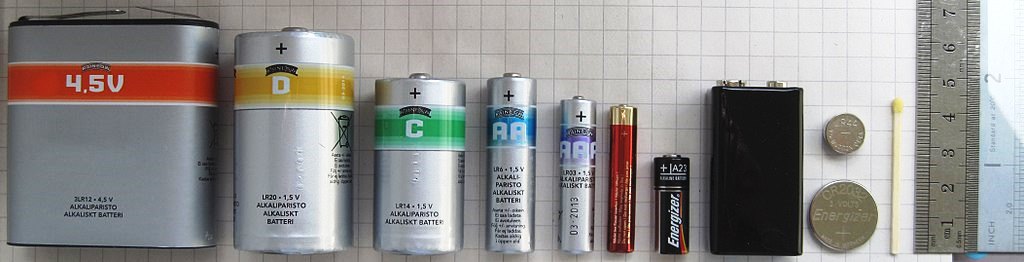
Most consumers just need to know the battery number to purchase and how to operate the device, and that’s a great relief off their shoulders we imagine.
Disclaimer: This article is a non-technical overview, not an authority piece.
Related
The Biggest Battery Breakthroughs in Time
More Reasons For Calling Batteries Batteries
Preview Image: Teyler’s Electric Machine, 1795 (MIT)