Japan’s contribution to batteries has been immense, especially with regards to recent progress with electric cars. Yet we seldom give a thought to Japans 19th Century efforts, perhaps because the island nation was behind a ‘bamboo curtain’ then. We hope to correct this oversight by heralding the efforts of early Japanese pioneers.
Japan’s Contribution: Early Work by Sakuma Shōzan

Sakuma Shōzan was a Samurai warrior born 1811 as a member of the military elite. He began studying Western sciences in 1855, after he adopted the mantra “Eastern ethics, Western technical learning”.
Sakuma Shōzan discovered electricity, glass, magnets, thermometers, cameras, and telescopes by reading Western textbooks.
After that, he built a hand-cranked generator, and a replica of the Daniell Battery in 1853. Sakuma promoted greater openness to the West until an assassin struck him down in 1864 with a single sword stroke. However, Japan’s contribution to battery science was destined to continue unabated after his death.
How Sakizou Yai Built on Shōzan’s Earlier Work
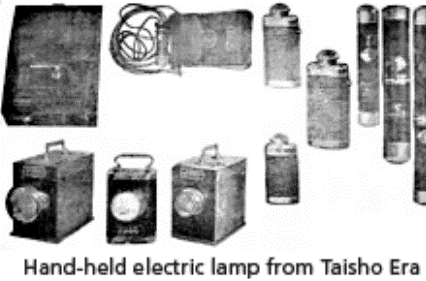
We know less about Sakizou Yai born 1863, perhaps because he was working class. He apprenticed as a watchmaker, and registered Japan’s first electrical patent for a ‘continuous’ battery powered electric clock.
However, he was not satisfied with the wet electric batteries at his disposal, because they leaked and froze in winter. He worked extremely hard at the problem. Finally, he invented a ‘dry cell battery’ by soaking a carbon rod in liquid paraffin that served as the electrolyte in 1887.
Sakizou Yai established a battery factory in 1910. This was after his dry batteries achieved great success in the Sino-Japanese War of 1894 to 1895. He was most successful against foreign competition and earned the title “king of the dry battery”. Tragically, his exertions lead to his early death. He died aged 66. His business died with him, although Japan’s contribution to battery science prospered to this day.
Related
What Toyota Plans For Electric Car Batteries
Akira Yoshino Wants Tougher E-Car Batteries
Preview Image: Sakuma Shōzan