We first came across lithium-sulfur batteries back in 2008, when they powered the longest solar airplane flight. The developers chose them, because the batteries were only as heavy as water. However the chemistry has failed to excite the interest of electric vehicle makers. That is until Florida International University came up with a lithium-sulfur battery range extender.
What Limits Lithium-Sulfur Battery Range?
Many electric vehicle owners are considering switching back to gasoline, according to the media release we link to below. This is because their driving range expectations are outpacing what the current generation of batteries can deliver.
However, the Florida International University team may have changed this reality with a key modification. Their research began 8 years ago, when high density lithium-sulfur batteries only survived 20 charging cycles.
This seemed a great pity to the team. The batteries were less expensive than pure lithium, despite their high ability to store energy. This hinted at a potentially longer lithium-sulfur battery range for electric vehicles, than other options.
You see, the longer period between battery recharging had a downside, that frustrated previous efforts. This seemed to tire the battery out faster. The best the Florida International University team achieved was 50 charging cycles.
The Tweak That Increased Lithium-Sulfur Lifespan
The team discovered what was going wrong earlier in their research. When lithium ions arrived at the sulfur side, they caused a chemical reaction. This unwanted side-effect formed polysulfides. These returned to the lithium side when they recharged the battery, causing premature deterioration.
Research is often a matter of trial and error. The researchers finally found their solution after 8 years. They added a small quantity of a platinum nano particle catalyst to the sodium side of the battery.
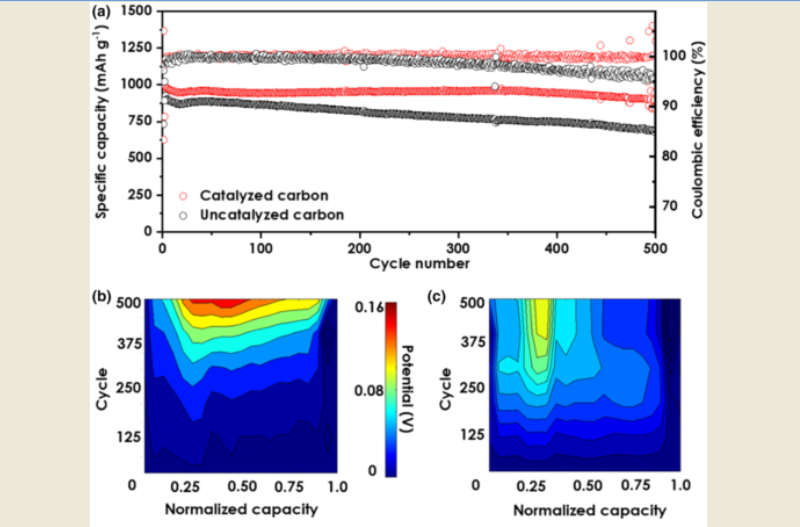
This moment of inspiration countered the troublesome reaction. After 500 charging cycles, the battery retained 92% of its original storage capacity! Can we look forward to a longer lithium-sulfur battery range for electric vehicles now?
More Information
Lithium Sulfur Batteries Deliver Fresh Hope
Healing Lithium-Sulfur Batteries With Iodine
Preview Image: Catalyzed Versus Un-catalyzed Performance