Researchers at University of Cincinnati believe their new lithium-based redox-flow battery could be the catalyst for future energy storage. We don’t use the term ‘revolution’ lightly. However, their membrane-free flow battery contains some of the elements we have been waiting for.
The State of the Energy Storage Market
The research report we link to singles out redox flow batteries (RFBs) in terms of their ability to decouple energy density and power. There are two main classes of these storage devices according to their electrolytes:
- Aqueous RFBs use water as their solvent for the anolyte and catholyte.
- Non-aqueous RFBs use non-water-based solvents opening other possibilities.
Developers have already made good progress with aqueous RFBs, leading to commercialization. However, they have low cell voltages and energy densities, limiting their applications.
Non-aqueous RFBs have a wider electrochemical window up to six volts, and potentially higher energy density too. However, and this has been the catch, the range of suitable ion-selective membranes is relatively small, and they are extremely expensive.
What Makes This Membrane-Free Flow Battery Special?
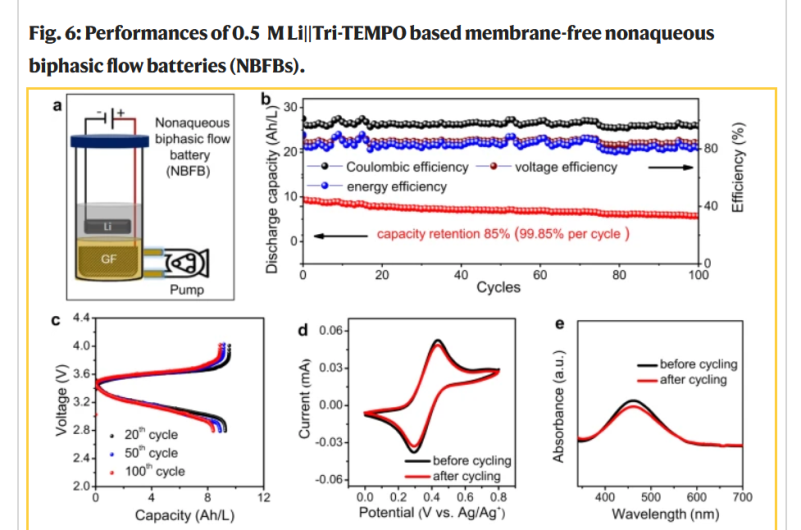
The University of Cincinnati team developed a high-voltage, membrane-free flow battery, which they claim overcomes those limitations. Their report confirms marked success across the following dimensions:
- Capacity retention of 98%, 98%, and 92% respectively for three different cathodes.
- Results were obtained after 100 cycles during less than 51 days at 27 °C / 80 °F.
The membrane-free flow battery they developed shows positive signs of being a viable alternative for large-scale grid storage. It could even become ‘revolutionary’, depending on how easy it is to mass-produce, and the extent the market takes up.
“Energy generation and energy consumption is always mismatched,” research leader Jimmy Jiang told The Independent. “That’s why it’s important to have a device that can store that energy temporarily, and release it when we need it.”
More Information
CMBlu Organic Solid Flow Battery Trial
300-Megawatt Organic Flow Battery