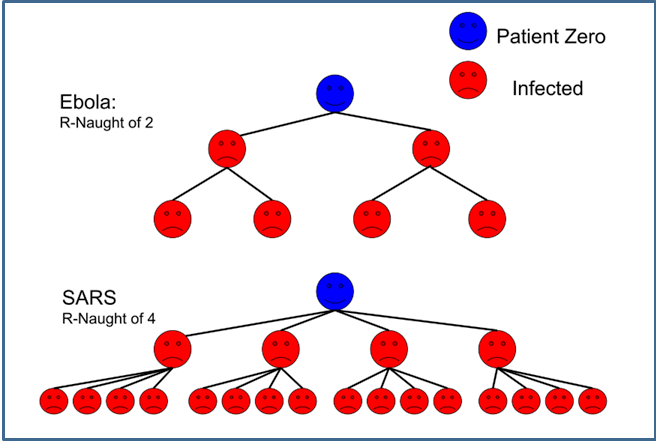
The R-Value is the expected number of new cases from a given infection. However, this is not an absolute number, because environmental factors may influence it. R-Values for Influenza, HIV/Aids, and Common Colds are 1.4 to 2.8, 2.0 to 5.0, and 2.0 to 3.0 respectively. While the global R-Value basic reproduction rate for COVID-19 without social distancing is 2.0 to 6.0.
Policy and R-Value Basic Reproduction Rate for COVID-19
Lock downs and other restrictions are strategies to reduce COVID-19 transmissions to manageable numbers. Face masking and social distancing could achieve a similar result, without adding to economic stress. They are therefore the preferred solution for most governments. However, if there’s a key to unlock universal public participation, we have yet to find it.
Governments therefore have to resort to harder lock down measures to limit the effective reproduction rate. Obviously, we’d prefer the R-Value basic reproduction rate for COVID-19 to be zero. Although in practice we can’t achieve much better than 1.0, while we wait for vaccines to do their work.
How an R-Value Over 1.0 Allows the Virus to Spread
R-Value management is a delicate technique. In April 2020, German chancellor Angela Merkel said if her nation’s rate stayed at 1.1, her country’s health system would be overwhelmed by October. This would pull forward to July and June with values of 1.2 and 1.3 respectively.
Lock downs should therefore start before a population crosses the 1.0 threshold to be truly effective. However, the challenge is many people consider them unnecessary at that point. That’s because they rely on gut feel things will work out, as opposed to trusting proven science.
The World Health Organization estimated the global reproduction rate for COVID-19 at 2.0 to 2.5 in early March 2020. The table below is the current situation in the U.S., state by state and it’s cause for concern.

Related
COVID-19 Infection Rate Is In Our Hands
Employers Considering Mandating Vaccine
Preview Image: Ebola and SARS R-Values