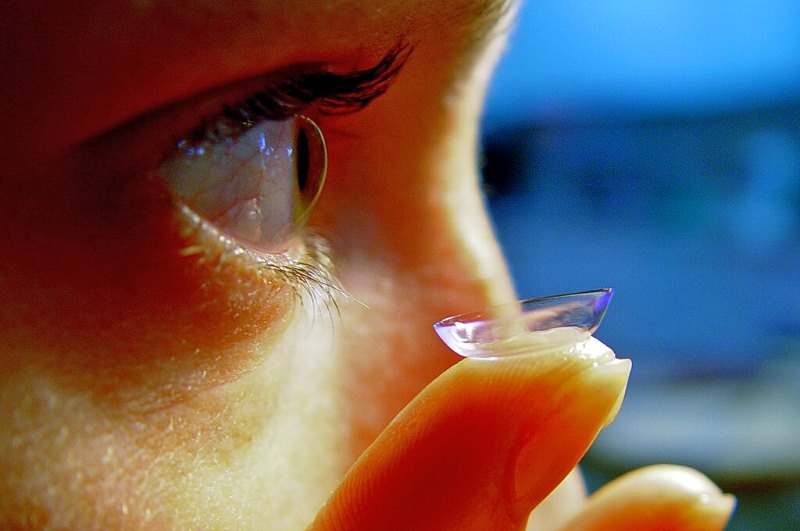
Did you ever notice how your vision changes for a moment when you surface from swimming underwater with your eyes open? This phenomenon lasts for as long as the moisture affects the shape of the eyeball. Optometrist have been using soft contact lenses to adjust for myopic short-sightedness this way for decades. Today we delve into the topic of organic smart contact lens batteries, that open many more possibilities.
More About Organic Batteries and Smart Contact Lenses
Smart organic-contact-lens developers wonder what else they could do with this concept someday. Perhaps their dream will come true of achieving more than improving a wearer’s natural eyesight. Maybe someday they will create alternative Google Glass heads-up displays, who knows anything is possible.
However, we do know we will need organic smart contact lens batteries to deliver energy to activate those devices. An article in Tech Explore caught our eye on August 24, 2023 regarding a salty, saline solution that could power smart contact lenses. This sounded like a battery to us, and so we decided to investigate further.
We learned that smart contact lenses already play a role in monitoring chronic diseases such as diabetes and glaucoma. But we will need onboard batteries without wires, or induction coils containing metal, to store the visual world around us as data. Researchers in Singapore are already moving this frontier forward.
Exciting Progress Made at Nanyang Technological University
Researchers at the university’s School of Electrical and Electronic Engineering agree smart contact lenses for medical and personal applications will require miniaturized power supplies. However, charging conventional batteries would require a miniaturized wired connection, or a wireless transmission unit.
The team knew this was impractical, and so they developed ‘tear-based bio-batteries integrated into contact lenses, that are charged by biofuel during their storage’ instead:
- Enzymatic reactions of glucose oxidase and self-reduction of conducting polymer charge the cathode and anode, respectively.
- Electrodes embedded in a contact lens discharge in an artificial tear solution, followed by bio-charging in a glucose solution.
Their next step could be exploring organic, natural tears instead of using artificial equivalents. We note with interest that the researchers were also able to energize their bio-rechargeable battery using an external power supply.
More Information
Could Organic Polymer Batteries Beat Lithium
Flow Battery with Simple Organic Electrolyte