A research team at Washington State University (WSU) may have achieved a quantum leap for lithium-metal batteries. That’s after Science Daily reported their new innovation could make these high-energy cells more practical for next gen energy stores. Their steps towards safe lithium metal batteries include applying a special protective layer around the lithium anode. This protects it from degradation while allowing the ions through.
More about This Step Toward Safe Lithium Metal Batteries
Lithium metal has the highest energy density among all solid materials we know. Therefore it can store more energy / electricity per unit of volume, and deliver power longer. That’s why we find lithium metal in most electronic devices, although they are not yet an optimum solution.
That’s because we have to compound lithium with another material to make it safe and this means we have less density. Min-Kyu Song, assistant professor in WSU School of Mechanical and Materials Engineering has another idea. If we can directly use the pure metal, he says we could improve the energy density dramatically. That in a nutshell are his steps towards safe lithium metal batteries
More about The Innovative Protective Layer
Min-Kyu Song and his team first packed selenium disulfide, a non-toxic chemical into a porous carbon structure for their cathode. This material is commonly used for anti-dandruff shampoos. Then they introduced two additives to the liquid electrolyte. The result was quite dramatic. The additives combined to form a dense, conductive layer around the lithium ion metal anode.
Moreover, this was sufficiently robust to prevent dendrites forming and recharged 500 times while retaining high efficiency. The research team at Washington State University is pressing on with its work to find a separator that will further enhance safety. We shall therefore watch this step towards safe lithium metal batteries with interest as news unfolds.
Related
Spray Painting Silicon Anodes for E Vehicles
Heating Lithium Batteries: a 2-Edged Sword
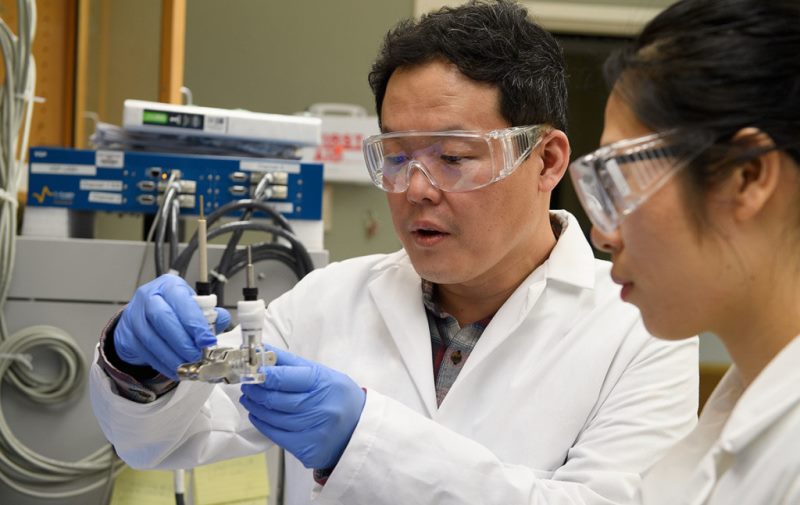
Preview Image: Testing a Prototype at Washington State University
Video Share Link: https://youtu.be/dh4Qf3qpPSg