Would you like to know the basics of liquid metal batteries? It’s a great topic, because they hold high promise for grid-scale storage some day. Liquid metal batteries can also ‘heal themselves’, meaning they can keep cycling for a long time.
So let’s dive in, and see what we can learn about these highly-efficient batteries, that use earth-abundant raw materials to store wind and solar energy.
What’s Inside Liquid Metal Batteries?
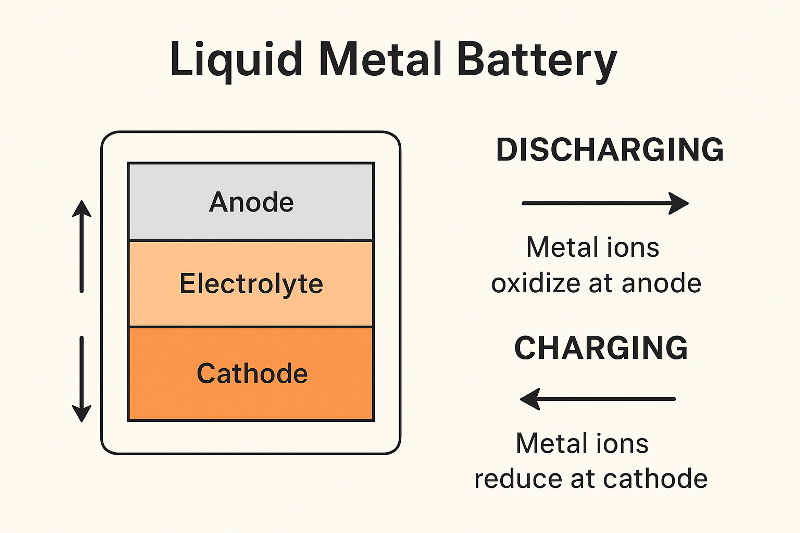
- The top anode layer in our picture contains a light, low-density metal such as sodium.
- The middle layer is a molten-salt electrolyte. This conducts ions between the electrodes, but not electrons.
- And finally, the bottom layer cathode is a dense, heavy metal or metalloid such as antimony, bismuth, or lead.
These three layers naturally form and separate due to differences in density. They are unable to mix together, and so a solid separator is unnecessary.
How These Three Parts Work Together
We continue with the basics of liquid metal batteries, by explaining how these three parts store and release energy working together:
- Charge-carrying ions leave the anode as the battery discharges. These travel through the molten salt electrolyte to the cathode where they form an alloy.
- This alloy is a mixture of the two electrode materials. As the battery charges, the alloy at the cathode end decomposes. The ions travel back to the anode end, where the original metal reforms.
Liquid metal batteries can repeat this dual process for many discharge-recharge cycles. This potentially suits them for utility grid storage.
Liquid Metal Batteries Sound Ideal – What’s the Catch?
We don’t see liquid metal batteries in our stores, because they operate between 250 and 500 °C / 480 and 930 °F, to keep all their layers melted. Fortunately for large-scale users, they have insulation that largely retains this heat.
However, there are several positives flowing from the basic design of liquid metal batteries. They have a long lifespan and minimum degradation, thanks to their components being metal. They also support high densities using relatively low cost, abundant materials.
But to restore the balance that makes these batteries less popular, they need an external source of heat to get them going. And so these promising batteries will probably remain on the back burner, at least for now.
More Information