Researchers at Karlsruhe Institute of Technology in Germany (KIT), teamed with other associates to explore factors affecting overall battery cell performance. Their to-do list included the interplays between chemical, electrical and mechanical forces. They hoped this information would guide them in the search for better battery materials.
The Search for Faster Charging Battery Electrodes
The research team used computer-based simulations to develop micro structural models for identifying and testing new electrode materials.
- Their primary focus was on optimizing battery performance and battery life.
- However, they were also keen to reduce the use of toxic and rare elements.
This specific study aimed to improve the design of sodium-ion batteries. This was because their structure was similar to lithium ion, except production was possible using local European materials. For example, sodium-nickel-manganese, and other layered oxides could be suitable for cathodes on this basis.
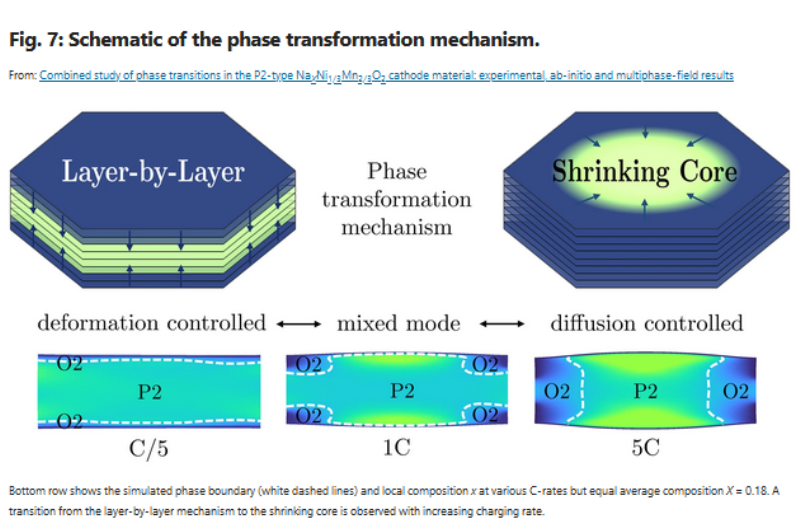
However, there was a catch to this approach according to Mirage News website. Sodium performs well during slow charging, leaving the cathode layer-by-layer. But during fast charging it leaves the cathode from all sides simultaneously , causing mechanical stress and perhaps permanent material damage too.
Practical Experiments To Back Up This Theory
The work we describe here was more than a paper simulation of a search for better battery materials. The researchers at KIT, and their associates combined their layered oxide, micro structured computer models with slow charge-and-discharge experiments in their laboratory.
Their sodium-nickel-manganese cathode displayed ‘several degradation mechanisms as predicted, leading to capacity loss’. The researchers concluded ist was not ready for commercial exploitation yet.
That’s because the crystal structure was liable to cracking leading to elastic deformation. Conducting research in a virtual world like this speeds up progress. And should help us achieve better batteries sooner.
More Information
How Good Is Sodium-Ion Technology
Prussian White Cathodes Enhance Sodium-Ion