Perhaps we have relied for too long on six feet to keep us COVID-safe indoors. Researchers at Massachusetts Institute of Technology say the six foot social distance rule is relative. They told Washington Post on April 27, 2021 it depends on situation-specific factors. These considerations include area size, ventilation, air filtration, occupancy, and the nature of the activity, for example.
A Handy Online Risk-Assessment Calculator
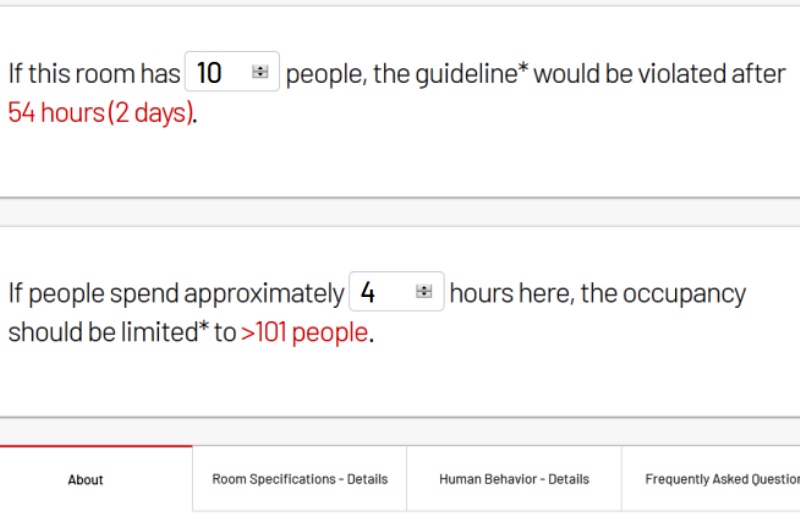
The predictive algorithm could be enough to make Google blush with all factors calculated and loaded. That’s why we were delighted to discover there’s a handy online risk-assessment calculator we link to below. Tell it about the room, the number of people, their age, and the activity and it assesses the risk.
However, the six foot social distance rule is not necessarily sufficient in itself to prevent airborne transmission. The study lead, MIT chemical engineering professor Martin Z. Bazant told Washington Post it should not lull us into ‘a false sense of security’. We still need to be smart, wear our face masks, and sanitize our hands and forearms as before.
The Six Foot Social Distance Rule Unpacked
The MIT team explains social distancing may offer some protection from pathogen-bearing aerosol droplets. That’s if they are sufficiently small to continuously mix through an indoor space. Therefore, the key factor is the ‘cumulative exposure time’. This is the ‘product of the number of occupants and their time in an enclosed space’.
Their risk-assessment calculator works out how long we can chance being in a particular indoor space, under the given circumstances. But some of their colleagues are not entirely sold on the idea. They point out the algorithm assumes ‘well mixed’ air in a room, and that is not always the case.
Related
Self-Swabbing By Volunteers Reveals Patterns
India’s COVID-19 Surge – What Went Wrong?
Preview Image: Online Risk-Assessment Calculator