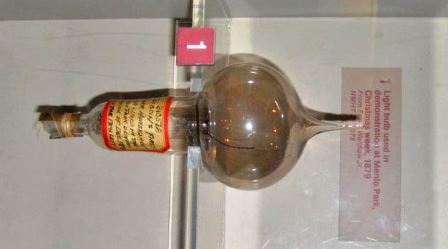
Thomas Edison was a serial inventor. He began his career tinkering with telegraphy equipment before inventing the first phonograph that recorded voice. He then moved on to dabbling with electricity. Everybody knows him for having invented a 110-volt light bulb. Following that, he went into electric power distribution. This triggered the War of Currents of which we write about next.
The Birth of Thomas Edison’s 110-Volt Light Bulb

One fine day in 1879, Thomas Edison by then aged 31 got the idea in his head of inventing an incandescent light bulb. He hoped to illuminate the streets where he lived, and so steal the market from oil and gas lighting companies.
He learned that he needed as thin a filament as possible to hold his costs down. At the same time, he needed a reasonable amount of power. Edison decided that 110 volts was about the right amount and this worked for him as history records the historic tale.
The Birth of the Edison Electric Light Company

The success of Edison’s 110-volt light bulb inspired him to form the Edison Electric Light Company in 1882 with several backers.
At the time of his first press conference, he said, “”We will make electricity so cheap that only the rich will burn candles.”
On September 4, 1882, he switched on his first power grid supplying 110 volts DC to 59 customers in lower Manhattan. Naturally this ensured they used his light bulbs which made commercial sense as Edison was learning.
Thus began the marvelous magic of electric lighting in our homes, although Edison’s success with a 110-volt light bulb was not the end of the story. Competition to supply electricity was getting hectic. The War of Currents was about to begin!
Related
The Aspiration of Thomas Edison to Improve EV’s Batteries
How to Make an Incandescent Light Bulb
Preview Image: World’s First Light Bulb
References Cited from Wikipedia
Empires Of Light: Edison, Tesla, Westinghouse, And The Race To Electrify (#54)