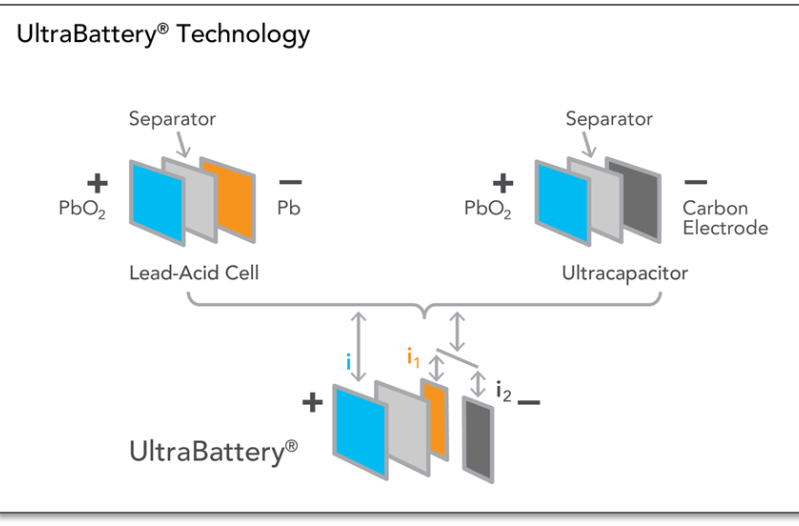
The UltraBattery hybrid is a modified, long-life lead-acid energy storage device that operates in a partial state of charge. This arrangement diminishes the deteriorating effects common to other lead-acid designs. It also enables faster recharging, and allows a longer, more cost-effective life than conventional lead-acid batteries.
Hybrid Technology at the Heart of the UltraBattery
Science Direct explains how the UltraBattery hybrid is a joint project between Australia-based CSIRO, and the Furukawa battery company of Japan. The device incorporates an asymmetric supercapacitor in parallel with a lead acid cell battery.
A conventional lead acid battery has a positive lead dioxide electrode, and a negative sponge lead one. This arrangement becomes sulfated over time during deep discharges, reducing its efficiency, capacity and power. Whereas this does not occur with a supercapacitor using a negative carbon electrode plate.
The UltraBattery merges these two technologies through a shared negative plate, enabling both to function asymmetrically. The total discharge current becomes the sum of the two. Hence full charges and discharges are no longer necessary, and less plate sulfating occurs.
Future Applications for Ultra Battery Hybrid Technology
The UltraBattery company has begun supplying storage batteries to wind and solar farms, enabling them to operate smoothly and predictably. It is also making inroads into the hybrid electric vehicle market, reducing carbon emissions in public space.
However, Wikipedia also foresees applications in standalone micro grids at commercial, industrial and residential sites. And also backup power for data centers we increasingly rely on to access our bulk information.
Moreover, these modified lead batteries could also help utility grids moderate frequency fluctuations, as renewable energy increasingly takes over from fossil fuels. When we consider these storage products are also fully recyclable, the only question is why it took so long to get here.
Recent Posts
The Big Unanswered Question About Lithium
The Future Life of Our Lead Acid Batteries
Preview Image: Functioning and Technology