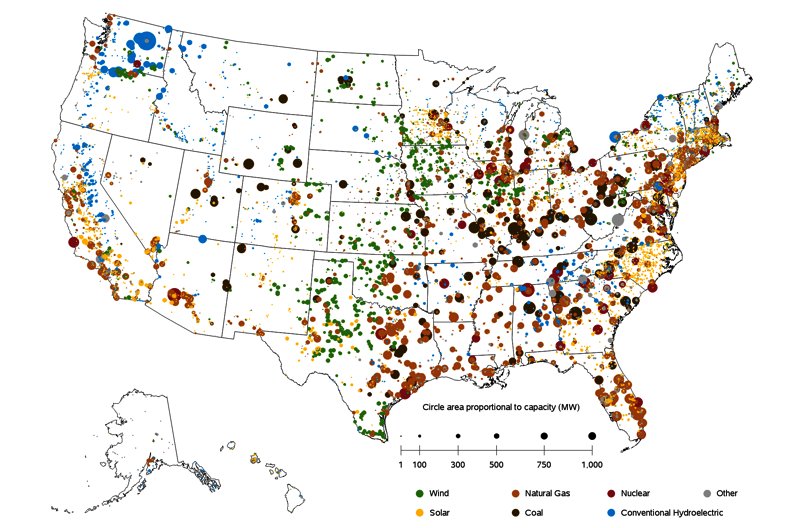
The United States still has only 4,605 megawatts of operational, utility-scale battery storage. This information from U.S. Energy Information Administration shows we need to curate this scarce resource carefully. Especially as they say utility scale battery performance depends on how we use this energy source.
Utility Scale Battery Performance Versus Power Stations
The 4,605 megawatts of operational utility-scale battery storage refers to its total power capacity. By comparison, the largest U.S. hydro power station Grand Coulee in Washington rates 6,809 megawatts.
While Arizona’s Palo Verde nuclear power station puts out nominal 3,942, followed by Florida’s gas-powered West County with 3,750. These ratings depend on operational parameters. Utility scale battery performance likewise depends on how we apply it.
Those power capacities refer to the greatest amount of energy those resources can deliver under ideal conditions. Power stations can do so for long, continuous periods. Whereas grid-scale batteries can only do so for a short period under continuous load. That’s why we obtain better service from them when we use them for electricity load shifting.
Factoring Electricity Load Shifting Into the Calculation
Electricity load shifting moves electricity consumption to a future time. In the case of grid scale batteries, a utility stores surplus green energy and releases it during peak demand. However, U.S. Energy Information Administration reports many older grid scale batteries have relatively shorter discharge cycles.
It recommends utilities use these for short-duration grid stability adjustments. Whereas more modern ones with longer duration cycles up to eight hours may be used for load shifting. This could enable a solar power station to remain operational after dark. As things stand, 40% of U.S. utility scale batteries are capable of performing both roles.
A recent U.S. Energy Information Administration survey predicts U.S. battery storage capacity will increase by 10 gigawatts this year. Over 60% of this will work in tandem with solar power stations. This will continue the trend of growing our renewable energy resource.
Breaking News
Climate Change is Result of Human Endeavor
Energy Storage in a Virtual Vault for Later
Preview Image: Utility Scale Generating Units