Lithium-ion batteries have assumed a central role in our increasingly electronic life. However, and this is the catch, their liquid electrolyte represents a significant risk to our safety. Scientists have been searching for a viable and safe gel alternative for a while. Tech Explore reports a team of researchers appears to have succeeded.
Advantages of a Viable and Safe Gel Alternative
Using a gel electrolyte would take lithium-ion batteries half way from liquid electrolyte, to full solid-state. This midway point could produce a more stable battery with enhanced storage density, and longer operating life.
However, and here’s the catch, forming gel electrolytes traditionally involves applying high heat, which may degrade the electrolyte. As a consequence, battery performance may decrease despite the additional cost. The interface-resistance between electrolyte and electrode may also be less than ideal.
A team of scientists associated with Pohang University (Department of Chemistry Science and Technology) in South Korea, has achieved a viable and safe gel. They did so by modifying conventional pouch cell technology per the link below.
What The Pohang University Team Came Up With
Tech Explore explains how the South Korean team developed a viable and safe gel for lithium-ion batteries. In simple terms:
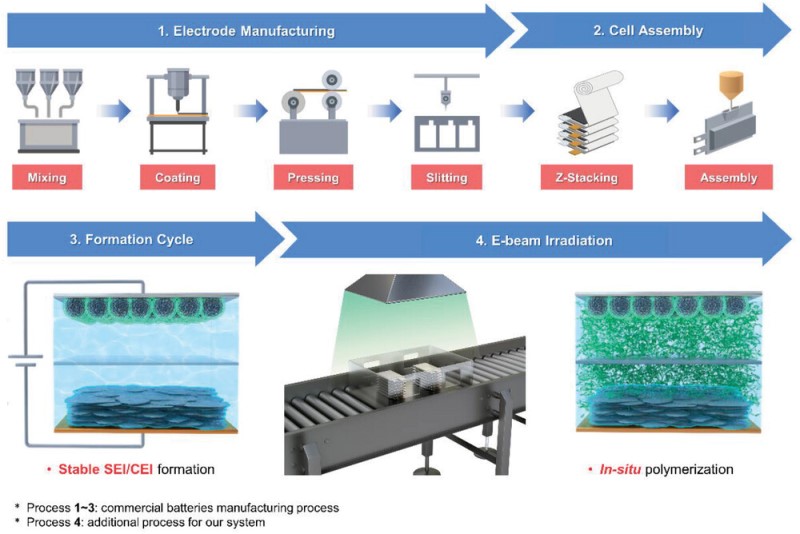
- They retained the conventional pouch-type battery assembly phases of preparing electrodes, adding electrolyte, activation, and removing gas.
- But they added dipentaerythritol hexaacrylate, and applied e-beam irradiation. This stabilized the electrode surfaces while forming the gel.
The gel for the electrolyte proved to have exceptional adhesion to electrode surfaces. It formed a ‘robust, polymer-rich surface’ at both the solid electrolyte, and cathode interphases. These measures protected the electrodes, reduced their vulnerability, and suppressed ‘detrimental side effects’.
The South Korean team believes their novel strategic direction should ‘proficiently confront’ the prevailing risks associated with contemporary high-capacity battery systems. And thereby guide the development of commercially viable, high-capacity, and inherently safe lithium-ion batteries.
More Information.
Aerogel Battery Shielding from Runaway Fires
AGM Battery Versus Gel Battery: Which Is Better?