Rechargeable lithium-ion batteries continue to be the most popular portable energy-storage device. The reasons for this are abundantly clear. They have high energy and power density, and should not normally lose capacity from the memory effect. However, they can suddenly fail when dendrites form inside them. We sometimes wonder what watching dendrites grow in real time would reveal.
Watching Dendrites Grow in Our Imagination
Dendrites can take some time to fully mature in a commercial lithium-ion battery, depending on the recharging routine. The phenomenon first caught the public eye in 2016, when several Samsung Galaxy Note 7 batteries caught fire.
Investigation revealed that dendrites had caused short-circuits between their anode and cathode electrodes. Later, we learned that dendrites can cause the electrolyte to decompose. This leads to a loss of active material, and with that some battery capacity.
Metallic lithium dendrites form when extra lithium ions accumulate on the anode surface, because it cannot absorb them. They may eventually penetrate the battery separator, touch the cathode on the far side, and cause a sudden discharge that generates considerable heat.
There was no way of watching dendrites grow in real time when the Samsung Galaxy Note 7 batteries caught fire. Samsung explained away what had happened by blaming undersized cases that bent negative electrodes. On another occasion the company blamed ‘an abnormal weld spot’.
Fast-Forward to August 24, 2020 and Some Answers
Battery Power Online reminded us of some remarkable research into the origins and dynamics of dendrites. Back in 2020 a team from the Center for Life Cycle Engineering (CALCE) at University of Maryland, achieved a break though.
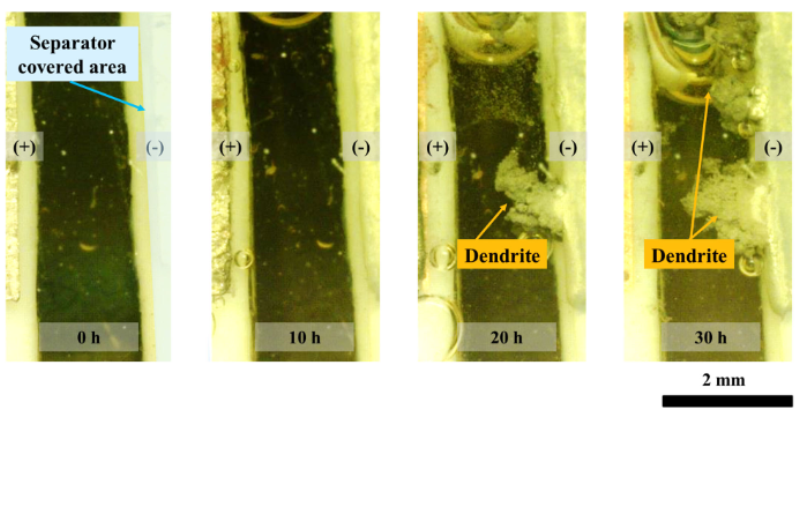
Some of the greatest ideas are simple after we stumble over them. The CALCE team created a transparent cell with two lithium electrodes. Then they passed a current through the cell, and observed dendrites form as the hours passed by.
They saw change happening in real time, while watching dendrites grow. The growth morphed from a flat ‘moss’ into sharp needle-like structures that finally penetrated the separator, and short-circuited the cell. In practice, the process takes far longer, but the principles are the same.
More Information
Rechargeable lithium-ion batteries continue to be the most popular portable energy-storage devices. The reasons for this are abundantly clear. They have high energy and power density, and should not normally lose capacity from memory effect. However, lithium-ion batteries can fail when dendrites form inside them. We sometimes wonder what watching dendrites grow in real time would be like.
Watching Dendrites Grow in Our Imagination
Dendrites can take some time to fully mature in a commercial lithium-ion battery, depending on the recharging routine. The phenomenon first caught the public eye in 2016, when several Samsung Galaxy Note 7 batteries caught alight.
Investigation revealed that dendrites had caused short-circuits between their anode and cathode electrodes. Later, we learned that dendrites can also cause the electrolyte to decompose. This leads to a loss of active material, and with that some battery capacity.
Metallic lithium dendrites form when extra lithium ions accumulate on the anode surface, because it cannot absorb them. Dendrites may eventually penetrate the battery separator, reach the cathode on the far side, and cause a discharge that generates considerable heat.
There was no way of watching dendrites grow in live time when the Samsung Galaxy Note 7 batteries caught fire in 2016. Samsung explained this away by blaming undersized cases that bent the negative electrodes. On another occasion the company blamed ‘an abnormal weld spot’.
Fast-Forward to August 24, 2020 and Some Answers
Battery Power Online reminded us of some remarkable research into the origins and dynamics of dendrites. Back in 2020 a team from the Center for Life Cycle Engineering (CALCE) at University of Maryland achieved a break though.
Some of the greatest ideas prove simple after we stumble over them. The CALCE team created a transparent battery cell with two lithium electrodes. Then the passed a current through the cell, and observed dendrites form as the hours passed by.
They saw change happening in real time, while watching dendrites grow. The growth morphed from a flat ‘moss’ into ‘sharp needle-like structures’ that finally penetrated the separator and short-circuited the cell. In practice, the process takes far longer, but the principles are the same.
More Information
What Samsung Said Re Its Galaxy 7 Phone