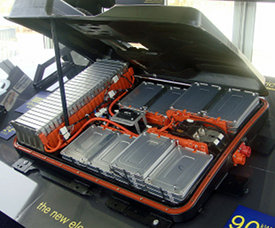
Electric vehicles in the future will need high-capacity batteries that recharge quickly, have very little degradation over time and operate safely. Lithium-ion (Li-ion) batteries, similar to the ones found in portable electronics, are currently the most promising, however, they do have some significant problems.
“Issues related to cost, power, energy density, and durability of Li-ion batteries have slowed their implementation in large-scale applications, such as electric and hybrid vehicles,” said Ruigang Zhang, a Toyota Motor Corporation scientist specializing in energy storage technology. “A rechargeable magnesium (Mg) battery system is one interesting candidate that offers much greater earth abundance than lithium and higher storage capacity — but the necessary research remains a challenge.”
Zhang and colleagues turned to the Center for Functional Nanomaterials (CFN) at the U.S. Department of Energy’s Brookhaven National Laboratory to probe molecular structures and track the rapid chemical reactions in these promising batteries.
“CFN possesses a full suite of powerful observational and analytical instruments,” said scientist Feng Wang of Brookhaven Lab’s Sustainable Energy Technologies Department, who will lead the collaboration with Zhang’s team at CFN. “With our newly developed imaging techniques, we are able to track the magnesium reactions in real time with nanoscale resolution, letting us understand how and why structural disorder emerges and impacts performance. And it is personally exciting to analyze and optimize materials that may one day make transportation more sustainable.”
In rechargeable batteries, ions are shuttled back and forth between the oppositely charged anode and cathode. The flow in one direction generates electricity (discharge). While applying external voltage causes flow in the other (charge).
Magnesium ions carry twice the intrinsic charge of lithium ions, meaning they store and deliver more energy. But as those ions move during each cycle, the billionth-of-a-meter structure of the battery material degrades and transforms.
The degradation rates and patterns, whether uniformed or asymmetrical, must be probed in a variety of conditions to understand the underlying mechanisms. Once pinpointed, scientists can then design new atomic architectures or customized compounds that overcome these obstacles to extend battery lifetimes and optimize performance.
The Toyota researchers plan to target the specific chemistry of a promising magnesium cathode composed of hollow carbon molecules called fullerenes. The compound offers consistent energy output, a rapid cycling rate and extremely low voltage hysteresis, meaning it stays relatively intact even after several cycles of charge and discharge.
At UPS Battery Center, our goal isn’t to only sell batteries, we want to inform and teach you about the amazing world of batteries, electricity and energy. Please check back for more interesting, helpful and informative articles about batteries and electricity.
Related Articles:
Electric Cars Do Not Pose Elevated Risk of Cancer from Electromagnetic Fields, Experts Say
New Electric Car Battery Decay Caused by Heat
Effect of Electric Vehicles on California’s Electricity Grid