A team of scientists from the U.S. Department of Energy’s (DOE) Brookhaven National Laboratory, Columbia Engineering, Columbia Physics and Kyoto University has discovered an unusual form of electronic order in a new family of unconventional superconductors.
The finding, described in the journal Nature Communications, establishes an unexpected connection between this new group of titanium-oxypnictide superconductors and the more familiar cuprates and iron-pnictides, providing scientists with a whole new family of materials from which they can gain deeper insights into the mysteries of high-temperature superconductivity.
“Finding this new material is a bit like an archeologist finding a new Egyptian pharaoh’s tomb,” said Simon Billinge, a physicist at Brookhaven Lab and Columbia University’s School of Engineering and Applied Science, who led the research team. “As we try and solve the mysteries behind unconventional superconductivity, we need to discover different but related systems to give us a more complete picture of what is going on-just as a new tomb will turn up treasures not found before, giving a more complete picture of ancient Egyptian society.”
Being able to harness the power of superconductivity, or the ability of certain materials to conduct electricity with no energy loss, is the key to creating a more energy-efficient future.
However, since most superconductors only work at very low temperatures, only a few degrees above absolute zero, or -273 degrees Celsius, they aren’t very useful in everyday life yet. The discovery, in the 1980s, of “high-temperature” superconductors that work at warmer temperatures (yet still not room temperature) was a giant step forward.
This offered scientists the hope that a complete understanding of what enables these materials to carry loss-free current would help them design new materials for everyday applications. Each new discovery of a common theme among these materials is helping scientists unlock pieces of the puzzle.
One of the biggest mysteries posed today, is trying to understand how the electrons in high-temperature superconductors interact. Sometimes they try to avoid each other, and at still other times they pair up the crucial characteristics that enable them to carry current with no resistance.
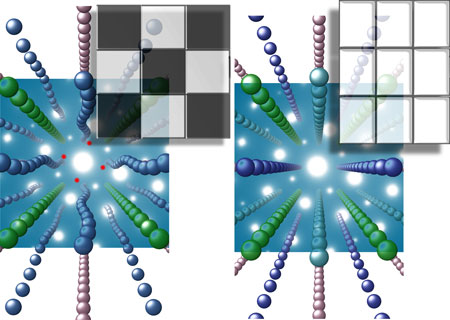
Scientists who have studied these materials, have discovered special types of electronic states, such as “charge density waves,” where charges huddle to form stripes, and checkerboard patterns of change.
Both of these break the “translational symmetry” of the material, the repetition of sameness as you move across the surface. When moving across a checkerboard, you move from red to black and then red again.
Another pattern scientists have discovered in the two most common classes of high-temperature superconductors is broken rotational symmetry without a change in translational symmetry.
In this case, called nematic order, every space on the checkerboard is red, however, the shapes of the spaces are rectangles, rather than squares. When you turn around on one space, your neighboring space is nearer or farther depending on the direction you are facing.
After observing this unexpected state in the cuprates and iron-pnictides, scientists were eager to see whether this unusual electronic order would also be observed in a new class of titanium-oxypnictide high-temperature superconductors discovered in 2013.
“These titanium-oxypnictide compounds are structurally similar to the other exotic superconductor systems, and they had all the telltale signs of a broken symmetry, such as anomalies in resistivity and thermodynamic measurements. But there was no sign of any kind of charge density wave in any previous measurement. It was a mystery,” said Emil Bozin, whose group at Brookhaven specializes in searching for hidden local broken symmetries. “It was a natural for us to jump on this problem.”
The team searched for the broken rotational symmetry effect, a research question that had been raised by Tomo Uemura of Columbia, using samples provided by his collaborators in the group of Hiroshi Kageyama at Kyoto University.
The team conducted two different diffraction studies: neutron scattering experiments at the Los Alamos Neutron Science Center (LANSCE) at DOE’s Los Alamos National Laboratory, and electron diffraction experiments using a transmission electron microscope at Brookhaven Lab.
“We used these techniques to observe the pattern formed by beams of particles shot through powder samples of the superconductors under a range of temperatures and other conditions to see if there’s a structural change that corresponds to the formation of this special type of nematic state,” said Ben Frandsen, a graduate student in physics at Columbia and first author on the paper.
The experiments revealed a telltale symmetry breaking distortion at low temperature. A collaborative effort among experimentalists and theorists established the particular nematic nature of the order.
“Critical in this study was the fact that we could rapidly bring to bear multiple complementary experimental methods, together with crucial theoretical insights-something made easy by having most of the expertise in residence at Brookhaven Lab and wonderfully strong collaborations with colleagues at Columbia and beyond,” Billinge said.
The discovery of nematicity in titanium-oxypnictides, together with the fact that their structural and chemical properties bridge those of the cuprate and iron-pnictide high-temperature superconductors, render these materials an important new system to help understand the role of electronic symmetry breaking in superconductivity.
At UPS Battery Center, our goal isn’t to only sell batteries, we want to inform and teach you about the amazing world of batteries, electricity and energy. Please check back for more interesting, helpful and informative articles about batteries and electricity.
Related Articles:
Superconducting Computer Chips with Increased Energy Efficiency
Analysis Of Manganese-Based Crystals Makes It A Possible Battery Candidate
What Is An Electrical Conductor
Scientists find a solution to long-standing mysteries of cuprate high-temperature superconductivity
Lev Davidovich Landau (1908-1968)