

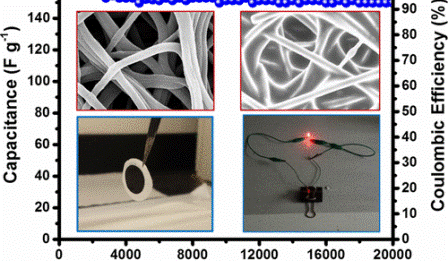
Capacitor and lithium-ion battery fires create newspaper headlines while the average seventeen gasoline fires per hour in the USA go largely unreported, per a Clean Technica report. Scientists are working around the clock to invent non-flammable batteries, and internal battery fire extinguishers. Now scientists at Drexel University may have found the key with solid electrodes they spin like cotton candy.
How the Scientists Spin Cotton Candy-Like Electrodes
The Drexel University team has been exploring ways to make solid electrodes for supercapacitors, which eliminate the possibility of fires. They invented a thin, furry sponge-material they infused with gelatin. Moreover, their ‘sponge’ is made of porous carbon nanofibers, and hence the product is non-flammable. They plan to apply the technology to battery electrodes next.
The scientists used an electrospinning process to create the spongy electrode mat. First, a ‘carbon-precursor polymer solution’ extruded through a rotating electric field. Then it deposited as a fibrous mat. Science Daily described this as ‘similar to making cotton candy at a microscopic level’. This sure helps us get our mind around a complex topic.

What Makes the Drexel Solid Electrodes Special?
Well firstly, the prototype electrodes have industrially relevant thickness and loading capacity. This renders them potentially suitable for commercial exploitation. Secondly, they are flexible like cloth and hence presumably foldable too. Moreover, the open-pore electrode is free of binding agents. In most other solid electrodes, binding agents behave like insulators and diminish performance.
Drexel’s durable, compact solid electrodes have better storage capacity, and longer recycling life than other similar devices. They continue working normally at temperatures up to 300º C, and so are unlikely to become a fire hazard.
This looks like a case of ‘hats off’ to the research team at Drexel University because this is a significant achievement. We shall remember you next time we buy cotton candy on sports day. We hope your success continues, and that you extend the technology to solid electrodes for batteries too.
Related
Is This the End of Lithium Battery Fires?
Flexible Graphene Supercapacitors on Clothes
Preview Image: Highly Durable, Self-Standing Solid-State Supercapacitor


