Every one of us has learned in grade school that there are three forms of matter: solid, liquid and gas. For many of us this is a universal truth, however the fact is that it’s not even half right. You must be thinking that I am fooling around, no…not at all. It has been proven to the world that there are at least six forms of matter available for us to study, which are: solids, liquids, gases, plasmas, Bose-Einstein condensates and Fermionic condensates.
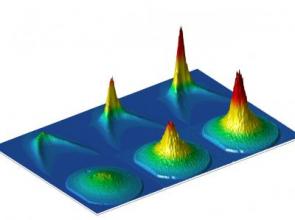
Fermionic condensates are recently discovered by an expert team from NASA. Nevertheless, here in this article we will be discussing only the fifth phase of matter, Bose-Einstein condensates also known as BEC. The BEC came into being in the year 1995, when researchers refrigerated particles called bosons to really low temperatures, thus making cold bosons that merge together to make a single super-particle. This single super particle is not like our regular matters and is more like a wave. These super particles are fragile.
In 1995, Ketterle made BECs in his lab by cooling a gas made of sodium molecules to a couple of hundred billionths of a degree above absolute zero. At such low temperatures the sodium molecules became more like waves than particles. Held together by magnetic traps and laser beams, these wavy atoms overlapped while forming a single gigantic matter wave.
Bose-Einstein condensates or the fifth phase of matter was anticipated by Indian physicist Satyendra Nath Bose and Albert Einstein in late 1920 when quantum mechanics was still new. Albert Einstein, despite the fact that he himself had discovered the BECs, found them to be too peculiar to be true.
But, at this moment we know Bose-Einstein condensates are real, although Einstein was right in saying: they are odd.
Related articles: