Robert Andrews Millikan is a famous American physicist who lived from 1868-1953. He was born in Illinois, in the small town of Morrison. His mother was a dean of women in a college in Michigan while his father was a Congregational minister.

Developing a love of physics
Although he was an excellent student in high school, he was not initially interested in physics or any scientific career for that matter. Millikan’s Greek professor saw his potential, and asked him to teach elementary physics during his junior year at Oberlin College. He spent one whole summer educating himself about physics to prepare for the teaching job. With this sprung the love of the field that eventually led to his many accomplishments.
After getting his degree in 1891, he continued in Oberlin for the next two years to get his masters in Physics. He also continued being an elementary physics instructor while he was there. He pursued a graduate career at Columbia University where he was appointed a Fellow in Physics. Millikan got his Ph.D. in 1895 after studying the polarization of the light emitted by an incandescent surface.
The Oil Drop Experiment and other research
During his studies, he was under the guidance of another well-known physicist, Michael Pupin. It was Pupin who taught him the value of experimental precision that probably helped him complete the experiment that he became famous for: the Oil Drop Experiment. This experiment, along with his works on photoelectric effect, got him a Nobel Prize in Physics back in 1923.
Millikan came up with the Oil Drop Experiment around 1908, together with Harvey Fletcher, his doctoral student. The aim of this experiment was to accurately measure the charge of an electron.
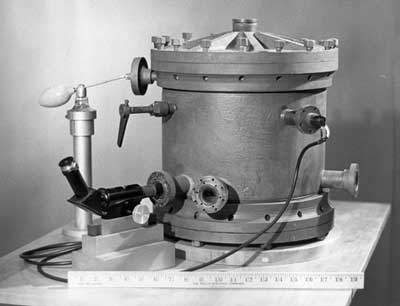
The apparatus used in the experiment featured a closed yet see-through chamber that had two parallel metal plates. One plate was at the top and the other at the bottom. A battery was connected to these plates to make one plate positive and the other negative. Millikan sprayed a mist of oil in the chamber – specifically over the top plate. This plate had a pinhole that limits a few droplets at a time to pass through the space between the plates. The space was ionized by radiation. This allowed the droplets to acquire electrons as they passed through. The drops were illuminated for visibility under a microscope. Millikan then adjusted the electric charge applied to the plates to see how it affected the downward motion of the droplets. The fall of the droplets was stopped when the upward electric force was balanced with the pull of gravity. Eventually, he observed that the charge was always a multiple of −1.5924(17)×10−19C.
This, he concluded, was the charge of a single electron. According to Wikipedia, he was only slightly off the currently accepted calculation.
After the success of the Oil Drop Experiment, Millikan used the same precision study on the photoelectric effect. It allows him to verify the equation of Einstein that established a linear relationship between energy and frequency.
Millikan also investigated the Brownian motion, ultraviolet spectra and the cosmic rays. He coined the words “cosmic rays” for ionizing radiation of extraterrestrial origin.