

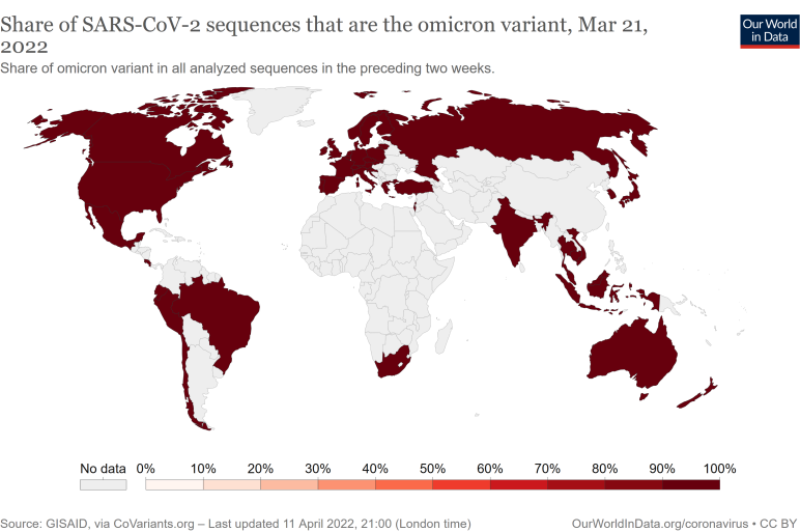
We’ve always known Omicron would generate new variants, since that’s in the nature of a virus. However, we never know how dangerous they will be until they arrive, because the process is random. Therefore we approach evidence of fresh Omicron sub-variants with caution.
What Evidence of Fresh Omicron Sub-Variants Reveals
Reuters news channel posted an update on April 11, 2022. It confirmed World Health Organization (WHO) is ‘tracking a few dozen cases of two new sub-variants of highly transmissible Omicron strain’. However, its first priority is to determine ‘whether they are more infectious or dangerous’.
The two sub-variants are part of an expanding number of varieties of Omicron variant BA:
1… There are at least 10 sub-variants of Omicron BA circulating.
2… WHO is tracking varieties BA.1, BA.2, BA.3, and BA.1.1.
3… The new sub-variants, BA.4 and BA.5 are now also on that list.
World Health Organization is sifting through the evidence of fresh Omicron sub-variants, to determine ‘their impact on immune escape potential’. Escape potential is the probability of a virus escaping a host carrier and bypassing recipient immunity.
What We Now Know of the Current Situation
New sub-variants BA.4 and BA.5 are present in South Africa and neighboring Botswana. All known cases are fully vaccinated, aged 30 to 50, and experiencing mild symptoms according to Reuters.
However, sub-variant BA.2 already dominates globally, with 94% of all sequenced cases worldwide. It is thus most likely to escape to new hosts, although it is no more likely to cause serious disease. By comparison, WHO says there are only a few dozen BA.4 and BA.5 cases on the global GISAID database.
However, UK Health Security Agency reported last week sub-variant BA.4 was also present in South Africa, Denmark, Botswana, Scotland and England during the latter half of March 2022. So once again the key appears to be international travel.
Breaking News
COVID Could Leave You Feeling Exhausted


