In the feverish race to discover thinner and thinner materials with the surface area and conductivity to make better performing battery electrodes, a lump of clay may just be the answer.
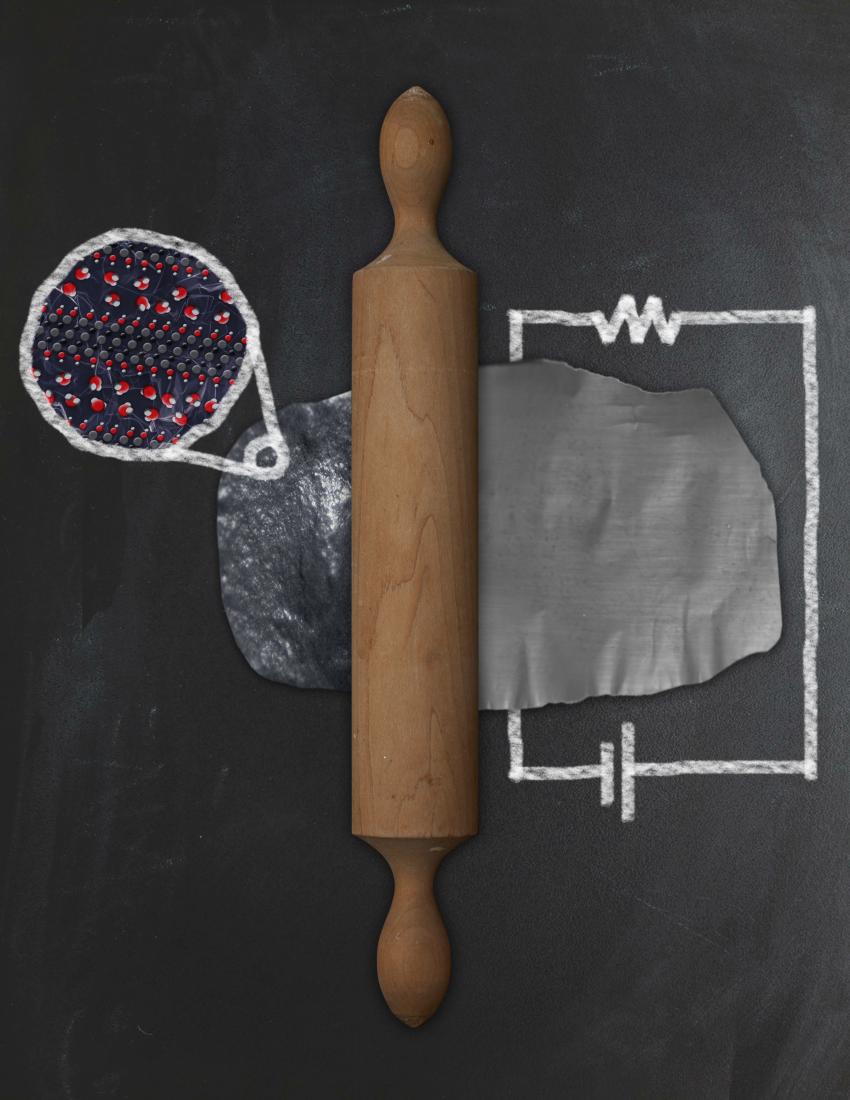
Drexel University’s College of Engineering scientists have invented clay which is both highly conductive and can easily be molded into a variety of shapes and sizes. It has been designed as a substitute for the rather complicated and costly processing that is currently used to make materials for lithium-ion batteries and supercapacitors, instead resembling rolling out cookie dough.
In an upcoming edition of Nature, researchers suggest a significant shift in the way electrodes for storage devices are produced. The clay, which already proves conductivity equal to that of metals, can be turned into a film, usable in an electrode, by simply rolling or pressing it out. Yury Gogotsi, PhD and co-author of the paper, explains:
Both the physical properties of the clay, consisting of two-dimensional titanium carbide particles, as well as its performance characteristics, seem to make it an exceptionally viable candidate for use in energy storage devices like batteries and supercapacitors. The procedure to make the clay also uses much safer, readily available ingredients than the ones we used to produce MXene electrodes in the past.
The key advantage to this material is its form, according to Michel Barsoum, PhD, and one of the inventors of MXenes:
As anybody who has played with mud can attest, clay is hydrophilic -water-loving. Clay is also layered and when hydrated, the water molecules slide between the layers and render it plastic that in turn can be readily shaped into complex shapes. The same happens here; when we add water to MXene, water penetrates between the layers and endows the resulting material with plasticity and moldability.
Graphene — a material widely studied for use in electrodes- on the other hand, is conductive but does not like water — it is hydrophobic. What we discovered is a conductive two-dimensional layered material that also loves water. The fact that we can now roll our electrodes rapidly and efficiently, and not have to use binders and/or conductive additives renders this material quite attractive from a mass production point of view.
The discovery came about while Michael Ghidiu, a doctoral student advised by Barsoum and Gogotsi in the Department of Materials Science and Engineering at Drexel, was testing a new method for making MXenes, two-dimensional materials invented at Drexel that are among the leading candidates for use in next-generation batteries and supercapacitors.
Ghidiu used a fluoride salt and hydrochloric acid instead hydrofluoric acid, which was the original chemical etching process pioneered at Drexel, to etch aluminum out of a titanium-based, layered ceramic material called a MAX phase, also discovered at Drexel by Barsoum.
These two ingredients, which are household names in chemistry class and are also much safer to handle than hydrofluoric acid, reduced the MAX phase to a pile of black particles. To stop the reaction and remove any residual chemicals, Ghidiu washed the material in water.
However, rather than finding the familiar layered MXene particles, he discovered that the etched sediment absorbed the water to form a clay-like material.
“We expected to find a slightly different material coming from the new process — but nothing like this,” Ghidiu said. We were just hoping for a safer, less expensive way to make MXenes, when something even better landed on the table.”
One of the first tests the team performed on the clay was to see if it could be pressed into a thin layer while retaining its conductive properties, after all, its initial goal was to make a conductive film. Ghidiu explains:
Being able to roll clay into a film is quite a contrast in production time, safety and cost when compared to the two most common practices for making electrode materials. Both the etching and peeling process used to make MXenes and a flaking, filtration and deposition method — like paper making — employ strong acids and costly, less common materials. The clay-making process is much simpler, quicker and safer.
All of these steps can be avoided, with the new discovery, greatly simplifying the processing. Now the researchers can simply etch the MAX phase, wash the resulting material and roll the resultant clay into films of various thicknesses, as Ghidiu expands upon the simplicity:
I would say the most important benefit to the new method — besides its increased capacitance — is that we can now make an electrode ready-to-go in about 15 minutes, whereas the total process before from the same starting point would be on the order of a day.
The clay’s readily available ingredients also make it more appealing when production is taken into consideration. This newly-discovered material is sure to increase efficiency and production times when it comes to lithium-ion batteries and supercapacitors.
UPS Battery Center is a leading manufacturer and supplier of sealed lead acid batteries for UPS systems, medical devices, alarm systems, and other industrial battery applications. We build reliable, high quality, new and refurbished products, and we recycle any qualified components as part of our green initiatives. UPS Battery Center is also a resource for relevant and current information about batteries, UPS systems, and the electrical industry.
Related Articles:
Bio-Batteries, A Step Closer to Clean Energy
A New Design for Making Cellulose Fibers
Transparent Solar Cells Look Promising for Batteries
How To Make Your Own Conductivity Meter
How To Turn Dough Into A Conductor And An Insulator