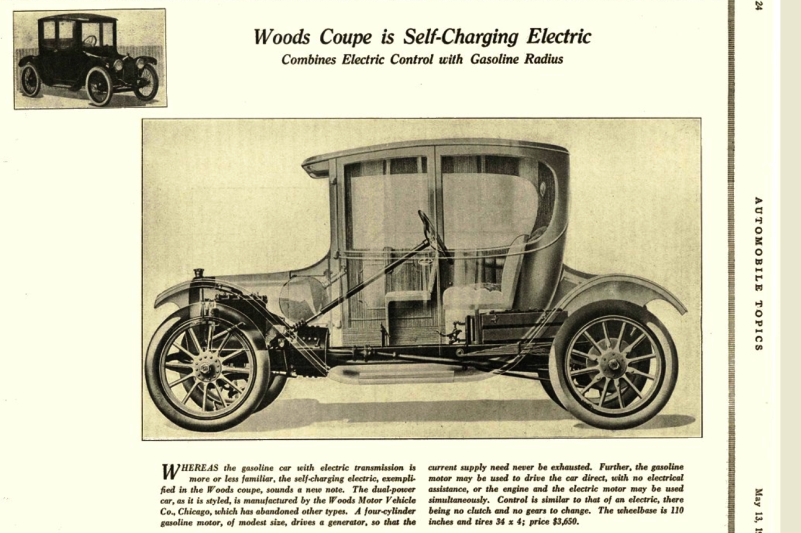
The 1916 Woods Dual Power hybrid auto may have been way ahead of its time in the early 20th century. However, it was not a commercial success in days when gasoline was cheap, and global warming was a future event. Nonetheless, it was a far-reaching innovation with the engine driving the car through the electric armature via a clutch.
Charging the Woods Dual Power Hybrid Battery
It was quite bothersome to start a gasoline motor for a short trip down town in 1916. Some entry-level autos still used hand cranks, and the engines were not always responsive at slow speeds. The Woods Motor Company believed they had a successful solution. Run the car on an electric motor up to 15 mph they said, and then let the gasoline take over.
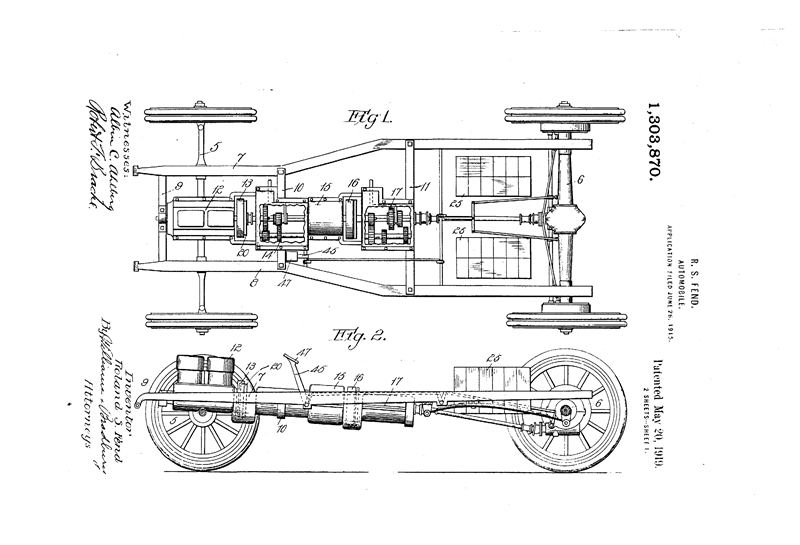
U.S. patent 1,303,870 reveals how engineers also included two innovations to charge the Exide batteries. The 1916 Woods Dual Power hybrid vehicle used regenerative braking when running electric. While the gasoline motor provided a full charge after it took over.
Alas, this was the last attempt by the manufacturer to stay in business. Their sales had been tumbling in the face of Henry Ford’s more efficient way of doing business. The hybrid option may also have sounded too complicated compared to the Model T’s simplicity. Whatever the case, the Woods Motor Company abandoned the idea in 1918, and shut down.
Technology Behind the Woods Dual Hybrid
The 1916 launch model was a four seater auto with a 14 hp, 4 cylinder gasoline motor. This coupled via an electromagnetic clutch to a 48 volt, 20 hp motor powering off a 24 cell Exide battery. There was no provision for remote charging. The field windings shunted when running on gasoline, converting the electric motor to a dynamo.
More Information
Early Hybrid Electric Cars In Context
Detroit Electric All American Runabout
Preview Image: Woods Dual Power Coupe
Technology Review in Edison Tech Center