Battery capacity is the total amount of electricity an electrochemical battery delivers in terms of ampere (amp) hours. For example, a battery with five-amp capacity can deliver five amps for one hour. Managing battery capacity is arguably the most important task from the user’s perspective. Although a battery management system (BMS) also manages voltage, current, and thermal factors too.
How Managing Battery Capacity is Critical
A battery module, or stack of cells in an EV is never in perfect balance. That’s because each individual cell has a slightly different rate of leakage, or self-discharge. This phenomenon is a consequence of cell chemistry, not manufacturing error.
An initially well-matched battery set may develop internal inconsistencies over time, according to Synopsys. This may be down to uneven charge-leakage, but also due to charging / discharging, elevated temperature, and calendar aging.
This combination of events can shift lithium-ion cells beyond their safe operating area (SOA). If charging tries to force over-maximum current into a cell, it can overheat, raising voltage to dangerous levels. This situation could spin out into an unhealthy operating state, and possibly permanent damage to the cell.
The Dilemma Faced by the Battery Series Array
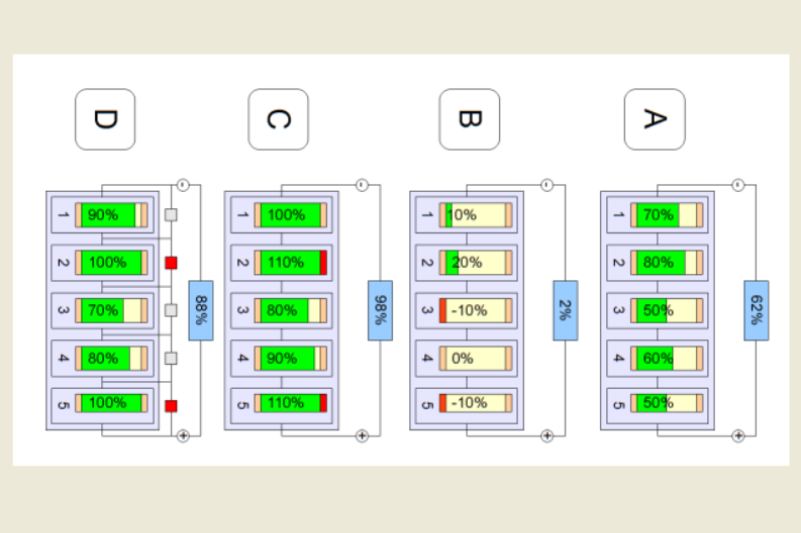
The battery series array determines the overall output of the installation. However, behind the scenes individual cells may be in disarray. If the top cell in a series reaches full charge prematurely, then the ones that follow after it may undercharge by default.
A good BMS should spring to the rescue and manage battery capacity more equitably. It could achieve this by balancing the state of charge (SOC) between the various modules. This may involve shuttling some voltage between them, and steering some voltage down to the next one in the series.
More Information
Better Solid State Batteries with New Pathways