

Chemistry, Oxford Languages informs us concerns the substances that make up matter. This is with particular reference to ‘their properties and reactions, and the use of such reactions to form new substances’. We delve into battery chemistry in this article. Read on to discover which substances are involved in batteries, and how these react together.
How Battery Chemistry Works: A Brief Overview
- Batteries are physical devices with electrodes that store chemical energy, and transform this into electrical energy.
- Chemical reactions inside batteries invoke the flow of electrons between the terminals via an external circuit.
- This flow of electrons constitutes an electric current. This energizes any electrical device in the external circuit.
- The flow of electrons alters the battery chemistry. Ions simultaneously flow between the electrodes restoring the balance.
Where Does a Battery Get Its Energy?
Clearly, a battery needs to get its energy from somewhere before it can perform. This process begins at one of the electrodes, where a chemical reaction releases electrons to flow to the other one:
- Batteries contain two electrodes. We call the negative electrode the anode, and the positive one the cathode.
- These are usually different metals, or other substances or compounds. There is also a third substance, the electrolyte.
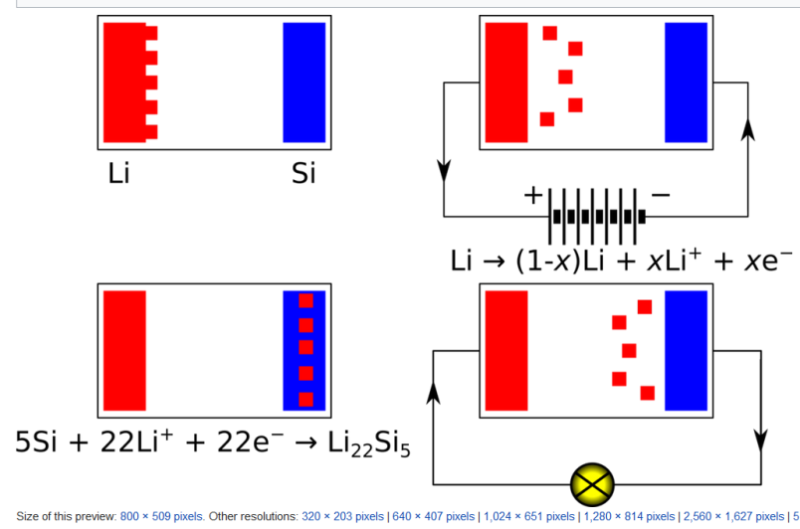
- Battery chemistry begins as the anode reacts with the electrolyte, to produce electrons which accumulate there.
- A second chemical reaction occurs at the cathode, which prepares it to receive those electrons via an external circuit.
Each of these reactions has what we call a particular standard potential. This term refers to its ability to transmit, or receive electrons. Any two, conducting materials can form an electrochemical cell, provided they have different standard potentials. This is the basis for the battery experiments we detail elsewhere on our blog.
More Information
Experiment: Light Up Your Life With Lemon Batteries
Experiment: Build an Aluminum Air Battery at Home


