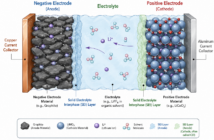
Lithium ion cells ionize their lithium atoms at their anodes during discharge, and separate these ions from their electrons. Clean Energy Institute at University of Washington explains how these separated ions move to the cathode through the electrolyte. There they meet the electrons arriving via an external circuit, where they recombine and electrically neutralize. Individual lithium-ion battery performance depends on the efficiency of this process.
Lithium-ion Battery Performance Delivers High Voltage and Capacity
Lithium ion battery cells currently use several different blends of materials. However, the commonest pair combines a lithium-cobalt-oxide anode with a graphite cathode. We encounter these sets in portable electronic devices such as smart phones and electric cars, where they typically team with an ether electrolyte.
Lithium-ion battery performance is superior in several ways to nickel-cadmium, and nickel-metal-hydride:
- The technology delivers one of the highest energy densities available today.
- This in turn enables the batteries to deliver large amounts of current.
- The system is relatively low maintenance, and does not need scheduled cycling.
- And finally, lithium ion cells do not have memory effect, affecting capacity.
Clean Energy Institute at University of Washington explains how a low self-discharge rate of around 1.5-2% per month also puts lithium-ion ahead of other batteries.
But Nothing Is Perfect in an Imperfect World
And yet, despite all these advantages, advanced lithium-ion battery performance has not seen off the competition. Why is this so? What is keeping the competition (including ourselves) so successful?
- Lithium ion batteries have a tendency to overheat and worse.
- High voltages can damage them and lead to thermal runaway.
- These disadvantages necessitate voltage-limiting mechanisms.
- This can add to their weight / cost which is already fairly high.
And finally, when all is said and done, no commercial battery including lithium-ion, can come anywhere close to gasoline in terms of energy density. Lithium-ion is not the energy cure-for-all we hoped for, any more than lead-acid was 150 years ago. Yet there is always hope, and so the work continues.
More Information
When Lithium-Ion Batteries Sleep What’s Best?
Tiny Movements inside Lithium Battery Cells