

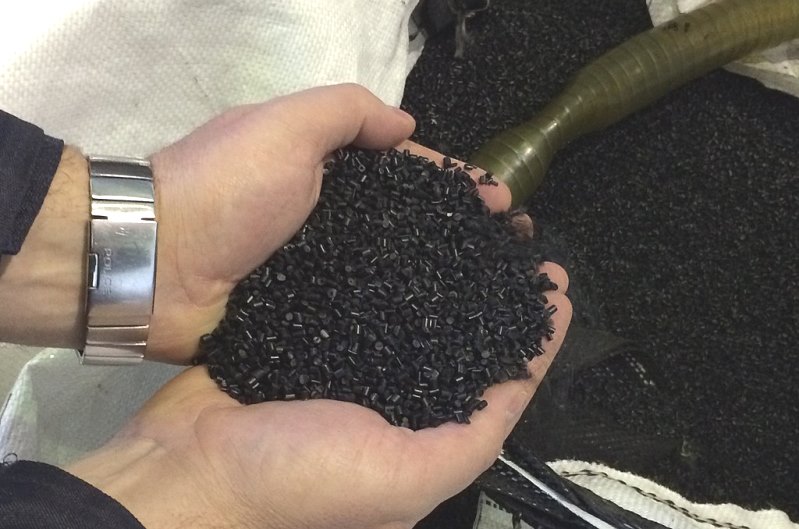
‘Black Mass’ is the term the battery-recycling-industry uses to describe crushed and shredded end-of-life battery cells. This mixture contains several valuable and relatively scarce metals including lithium, manganese, cobalt and nickel. Processing battery black mass remains a challenge, because unlike lead-acid batteries, lithium-ion cells do not dismantle easily.
Reducing End-of-Life Lithium-Ion Battery Cells to Black Mass
- The process begins with sorting, discharging, and then taking batteries apart.
- Mechanical crushing, drying, sorting, and sieving the components follows.
- Then it is time to use pyrolysis to heat the residue to as much as 700°C.
- This should remove any electrolyte and / or fluoride residue from the black Mass.
Circular Energy Storage estimates black mass from end-of-life lithium-ion batteries will reach 1.2 million tons by 2030. This will harbor 25,000 tons of lithium, 35,000 tons of cobalt, and 86,000 tons of nickel all of which we should recover.
Alfred H Knight consultants (AHK) assayed a black mass sample from Europe, and concluded it comprised:
- 15.79% cobalt, 6.94% nickel, 4.82% manganese, 3.19%, lithium …
- 1.97% copper, 5.13% aluminum and other sundry components.
An assay report like this would yield a rich mine indeed! However, processing battery black mass requires a different set of skills.
AHK Technical Department Typecasts Black Mass Materials
Alfred H Knight consultants decided to set a standard for black mass components in terms of:
- Phase chemistry and morphological characteristics.
- Grain size, composition and textural variability in unprepared state.
- A similar profile for crushed and dried, powdered and prepared material.
Their detailed analysis produced the following benchmarks from their sample for processing battery black mass in a controlled fashion:
- The particles were texturally complex, and with mixed phases.
- Aluminum foils were coated with lithium metal oxide compounds.
- Copper foil had complex 3D textures and morphologies,
- Light elements such as lithium were visible under laser spectrometry,
This information, if wisely used, could prove invaluable in understanding black mass better. This in order to recycle it in meaningful quantities and cost-effectively too. This cost factor is becoming critically important, because lithium-ion batteries influence so many aspect of our lives.
More Information
Joule Heating Battery Waste for Recycling
Recycling E-Cigarettes in a Time of Need


