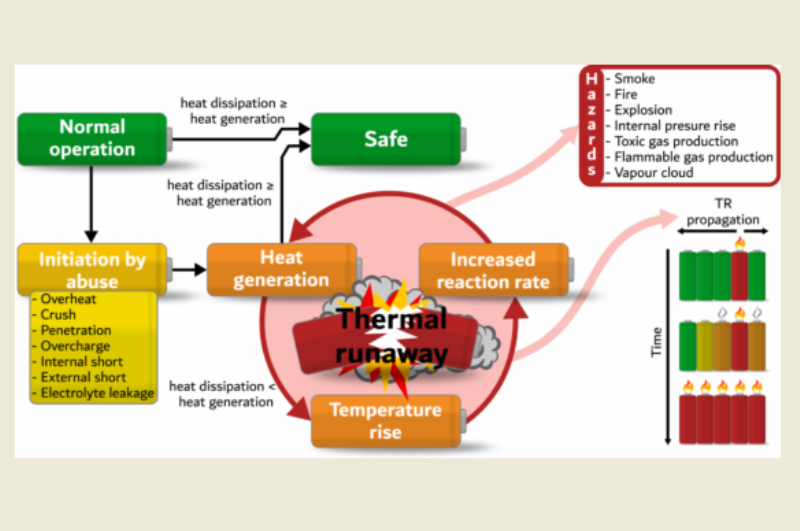
Thermal runaway in lithium-ion batteries occurs when they enter an uncontrollable, self-heating state. Scientists at Department of Chemical & Biological Engineering, University of Sheffield, England compared lithium-iron-phosphate (LFP) and nickel-manganese-cobalt (NMC) chemistries. They confirmed that thermal runaway in LFP and NMC batteries releases gases in both instances.
Thermal Runaway: LFP and NMC Battery Architecture
LITHIUM-IRON-PHOSPHATE BATTERIES
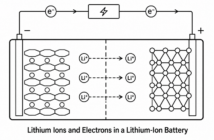
LFP batteries have lithium-iron-phosphate cathodes, and graphitic carbon anodes with metallic backings. These are most likely to have an organic lithium-salt electrolyte controlling the flow of electrons between them.
The lithium-iron-phosphate cathode is the source of the lithium ions in the battery. It tolerates temperatures up to 70°C (160°F) without adverse reactions, but at a range of 105 to 135°C (220 to 275°F) it releases oxygen fueling thermal runaway.
NICKEL-MANGANESE-COBALT BATTERIES
NMC batteries, on the other hand, use a combination of nickel, manganese and cobalt as their cathode material. They may have silicon-based anodes, and lithium hydroxide solvents as electrolytes, although there are other possibilities.
NMC batteries may enter thermal runaway for a variety of reasons, as a result of internal failures or external events beyond their control. Their lithium-hydroxide electrolyte may vent gas, or release at temperatures in the range 150 to 200°C (302 to 392°F)
What the Scientists At University of Sheffield Determined
The Sheffield team confirmed the following in terms of thermal runaway in LFP and NMC batteries:
- Nickel-manganese-cobalt batteries generate larger specific gas volumes during thermal runaway.
- But lithium-ion-phosphate battery gases are more toxic and flammable, depending on their state of charge.
The research report (see link below) determines that gases released by LFP batteries during thermal runaway are far more flammable than NMC emissions. However, the chances of battery thermal runaways per se are greater with NMC chemistry.
More Information
Lithium Iron Phosphate Battery Particles
Thermal Runaway Gas Production Factor